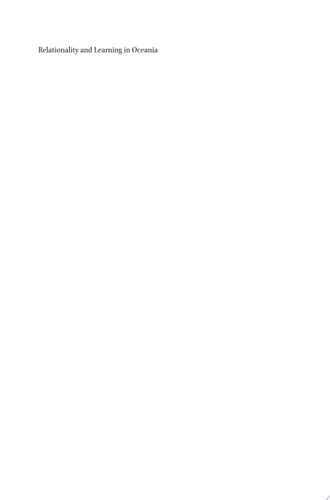
Relationality and Learning in Oceania: Contextualizing Education for Development
0
0
As an Amazon Associate and affiliate partner, Menrva Books earns from qualifying purchases. Learn more
Author Description
This multi-authored volume draws on the collective experiences of a team of researcher-practitioners, from three Oceanic universities, in an aid-funded intervention program for enhancing literacy learning in Pacific Islands primary education schools. The interventions explored here—in Solomon Islands and Tonga—were implemented via a four-year collaboration which adopted a design-based research approach to bringing about sustainable improvements in teacher and student learning, and in the delivery and evaluation of educational aid. This approach demanded that learning from the context of practice should be determining of both content and process; that all involved in the interventions should see themselves as learners. Essential to the trusting and respectful relationships required for this approach was the program’s acknowledgement of relationality as central to indigenous Oceanic societies, and of education as a relational activity. Relationality and Learning in Oceania: Contextualizing Education for Development addresses debates current in both comparative education and international aid. Argued strongly is that relational research-practice approaches (south-south, south-north) which center the importance of context and culture, and the significance of indigenous epistemologies, are required to strengthen education within the post-colonial relational space of Oceania, and to inform the various agencies and actors involved in ‘education for development’ in Oceania and globally. Maintained is that the development of education structures and processes within the contexts explored through the chapters comprising this volume, continues to be a negotiation between the complexity of historically developed local 'traditions' and understandings and the ‘global’ imperatives shaped by dominant development discourses.
Menrva's Summary
THE THESIS
This volume investigates how relationality and context-specific cultural understanding are essential for effective educational development in Oceania. The book draws on the experiences of researcher-practitioners from three Oceanic universities involved in an aid-funded literacy enhancement program in Solomon Islands and Tonga. It explores a four-year collaboration that utilized a design-based research approach to achieve sustainable improvements in teacher and student learning, and in the delivery of educational aid. The core argument is that research-practice approaches must prioritize context, culture, and indigenous epistemologies to strengthen education within Oceania's post-colonial landscape.
THE SCOPE MAP
- Case studies from literacy learning interventions in Solomon Islands and Tonga.
- An exploration of design-based research as a methodology for educational development.
- Analysis of the role of relationality and indigenous epistemologies in Oceanic societies.
- Discussion of the negotiation between local traditions and global development discourses in education.
THE AUTHORITY PERSPECTIVE
The book is positioned as a contribution to debates in comparative education and international aid, arguing for the necessity of context- and culture-centered research-practice approaches. It emphasizes the importance of indigenous epistemologies and relationality in strengthening education within Oceania. The work likely appeals to academics, policymakers, and practitioners involved in education for development, particularly within the Pacific region. The authors advocate for south-south and south-north collaborations that respect local contexts.
Page Count:
188
Publication Date:
2020-02-25
Publisher:
BRILL
ISBN-10:
9004425314
ISBN-13:
9789004425316
Non-Fiction
Education
Sociology
Community Tags
Similar Books




Reader Comments
Share Your Thoughts
No comments yet. Be the first to share your thoughts!