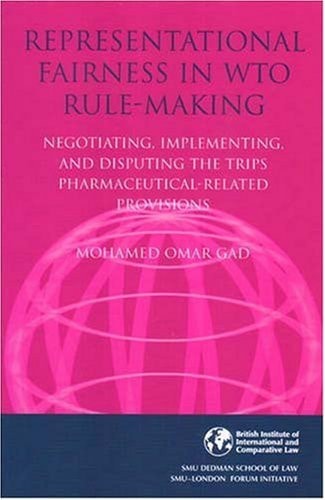
Representational Fairness in WTO Rule Making: Negotiating, Implementing and Disputing the TRIPS Pharmaceutical-Related Provisions
0
0
As an Amazon Associate and affiliate partner, Menrva Books earns from qualifying purchases. Learn more
Author Description
This book examines representational fairness in WTO rule making. The context of examination is the pharmaceutical-related provisions of the TRIPS (Trade-Related Aspects of Intellectual Property Rights) Agreement and the interests of developing countries and pharmaceutical multinational enterprises therein. The book analyzes the negotiation and implementation periods of the specified TRIPS provisions and the legal disputes that arose, covering the period from the mid-1980s, until the adoption of the Doha Declaration on the TRIPS Agreement and Public Health in November 2001. An imbalance reflected in the negotiated text in favor of pharmaceutical MNEs' interests during the negotiation process is characterized as 'top-down' rule making. Reacting to this, developing countries exerted pressure from the 'bottom-up' hindering the implementation of these TRIPS provisions. This retorting action, while instilling a degree of balance, congests the TRIPS regime and the larger WTO system with additional dispute proceedings leading to strains in North-South relations. The volume concludes with selective suggestions focusing on the rule making process of the WTO and proposes measures to reduce the likelihood of a deficiency in representational fairness occurring in future negotiations.
Menrva's Summary
THE THESIS
This book investigates the concept of representational fairness within the World Trade Organization's rule-making processes, specifically focusing on the TRIPS Agreement's pharmaceutical-related provisions. It analyzes how the interests of developing countries and multinational pharmaceutical enterprises were balanced during the negotiation, implementation, and dispute stages of these provisions, particularly from the mid-1980s until the Doha Declaration in 2001. The study characterizes the initial negotiation phase as 'top-down' rule making, favoring pharmaceutical MNEs, which led developing countries to exert 'bottom-up' pressure, hindering implementation and increasing dispute proceedings. The author concludes by proposing measures to enhance representational fairness in future WTO negotiations.
THE SCOPE MAP
- Analysis of representational fairness in WTO rule making.
- Focus on the pharmaceutical-related provisions of the TRIPS Agreement.
- Examination of the interests of developing countries and pharmaceutical multinational enterprises.
- Detailed study of the negotiation and implementation periods of TRIPS provisions.
- Coverage of legal disputes arising from the TRIPS Agreement.
- Analysis of the period from the mid-1980s to the Doha Declaration (November 2001).
- Characterization of 'top-down' rule making favoring MNEs.
- Exploration of 'bottom-up' resistance by developing countries and its consequences.
THE AUTHORITY PERSPECTIVE
The book examines the complex dynamics of international trade law and intellectual property, particularly concerning the TRIPS Agreement and its impact on developing nations. It highlights the tension between corporate interests and the needs of less developed countries within global governance structures. The analysis suggests that while developing countries' resistance created a degree of balance, it also led to congestion within the WTO system and strained North-South relations. The work concludes with recommendations aimed at improving the fairness of future WTO rule-making processes.
Page Count:
333
Publication Date:
2006-09-28
Publisher:
British Institute of International and Comparative Law (BIICL)
ISBN-10:
1905221045
ISBN-13:
9781905221042
Non-Fiction
Economics
Politics
Intellectual Property
International Trade
Developing Countries
WTO
Community Tags
Similar Books