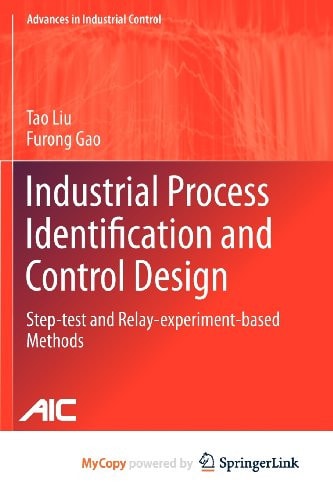
Industrial Process Identification and Control Design: Step-test and Relay-experiment-based Methods
0
0
As an Amazon Associate and affiliate partner, Menrva Books earns from qualifying purchases. Learn more
Author Description
Industrial Process Identification and Control Design is devoted to advanced identification and control methods for the operation of continuous-time processes both with and without time delay, in industrial and chemical engineering practice. The simple and practical step- or relay-feedback test is employed when applying the proposed identification techniques, which are classified in terms of common industrial process type: open-loop stable; integrating; and unstable, respectively. Correspondingly, control system design and tuning models that follow are presented for single-input-single-output processes. Furthermore, new two-degree-of-freedom control strategies and cascade control system design methods are explored with reference to independently-improving, set-point tracking and load disturbance rejection. Decoupling, multi-loop, and decentralized control techniques for the operation of multiple-input-multiple-output processes are also detailed. Perfect tracking of a desire output trajectory is realized using iterative learning control in uncertain industrial batch processes. All the proposed methods are presented in an easy-to-follow style, illustrated by examples and practical applications. This book will be valuable for researchers in system identification and control theory, and will also be of interest to graduate control students from process, chemical, and electrical engineering backgrounds and to practising control engineers in the process industry.
Menrva's Summary
THE THESIS
This book investigates advanced methods for identifying and controlling continuous-time industrial processes, focusing on step- and relay-feedback tests. It presents identification techniques tailored for open-loop stable, integrating, and unstable processes, followed by corresponding control system design and tuning models for single-input-single-output systems. The work further explores two-degree-of-freedom control strategies and cascade control for improved set-point tracking and disturbance rejection, alongside detailed methods for multiple-input-multiple-output processes including decoupling, multi-loop, and decentralized control. Iterative learning control is also introduced for achieving perfect tracking in uncertain batch processes.
THE SCOPE MAP
- Identification and control design for continuous-time processes with and without time delay.
- Application of simple and practical step
- or relay-feedback tests for identification.
- Classification of identification techniques based on common industrial process types: open-loop stable, integrating, and unstable.
- Design and tuning models for single-input-single-output (SISO) control systems.
- Exploration of two-degree-of-freedom control strategies and cascade control system design.
- Methods for independently improving set-point tracking and load disturbance rejection.
- Detailed techniques for multiple-input-multiple-output (MIMO) processes: decoupling, multi-loop, and decentralized control.
- Application of iterative learning control for perfect tracking in uncertain industrial batch processes.
THE AUTHORITY PERSPECTIVE
The book is presented as a valuable resource for researchers in system identification and control theory, as well as graduate control students and practising control engineers in the process industry. The methods are described as being presented in an easy-to-follow style and illustrated with examples and practical applications. The focus on step- and relay-experiment-based methods suggests a practical, hands-on approach to control design. The comprehensive coverage from SISO to MIMO systems indicates a thorough treatment of the subject matter.
Page Count:
474
Publication Date:
2011-11-19
Publisher:
Springer London
ISBN-10:
0857299786
ISBN-13:
9780857299789
Science
Non-Fiction
Control systems
Process Engineering
Engineering
Industrial Automation
Chemical Engineering
Community Tags
Similar Books