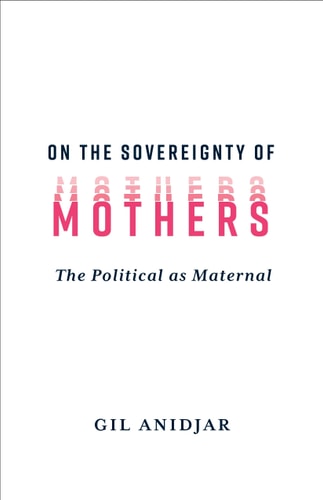
On the Sovereignty of Mothers: The Political as Maternal
0
0
As an Amazon Associate and affiliate partner, Menrva Books earns from qualifying purchases. Learn more
Author Description
All mothers write when they inscribe themselves onto their children and onto the world. We must take the measure of this field of inscription, the maternal field, and rethink mothers in terms that far exceed the body and the family, the tribe or the nation. On the Sovereignty of Mothers seeks to contribute to political philosophy from multiple perspectives: religion; feminism, sex, gender, and critical race studies; psychoanalysis; marxism; and personal reflection. Gil Anidjar reads the biblical story of Hagar and Sarah as the founding (if ignored) scene of what Hegel famously called "the dialectic of master and slave." Reconsidering the meaning of motherhood and of slavery in what binds and separates them, he argues that the two, particularly as they were read by Saint Paul, illuminate and perhaps govern the history as well as the political economy of motherhood. The dialectic of mother and slave prompts us, with James Baldwin and Hortense Spillers, to rethink race and gender in these terms. Recognizing that Ishmael and Isaac, the children of Hagar and Sarah, had two mothers-as did Moses, Buddha, Socrates, Oedipus, and Antigone-one of whom had absolute authority over the other, has not led to any theoretical advance, much less to a reconsideration of motherhood. Drawing on Hobbes's view of women's elevated status in the state of nature and Foucault's notion of pastoral power, the book identifies the maternal contract by which mothers have the power to preserve and to destroy (exemplified by abortion and infanticide) as the essence of sovereignty and the political
Menrva's Summary
THE THESIS
This book investigates the concept of maternal sovereignty as a foundational element of political philosophy. Gil Anidjar, drawing on a range of disciplines including religion, feminism, psychoanalysis, and Marxism, re-examines the biblical narrative of Hagar and Sarah to propose a new understanding of motherhood. The work explores the political economy of motherhood, its relationship to slavery, and its implications for race and gender, referencing thinkers from Hegel and Saint Paul to Hobbes and Foucault. Anidjar posits that the maternal contract, granting mothers the power to preserve or destroy, is central to the essence of sovereignty.
THE SCOPE MAP
- Analysis of the biblical story of Hagar and Sarah as a founding scene for the master-slave dialectic.
- Reconsideration of motherhood and slavery, exploring their connections and distinctions.
- Examination of race and gender through the lens of motherhood, referencing James Baldwin and Hortense Spillers.
- Exploration of the concept of multiple mothers for a single child, as seen in figures like Moses, Buddha, and Oedipus.
- Integration of Hobbes's views on women in the state of nature and Foucault's concept of pastoral power.
- Identification of the 'maternal contract' as the core of sovereignty, encompassing powers of preservation and destruction.
- Discussion of the political implications of abortion and infanticide within the framework of maternal sovereignty.
THE AUTHORITY PERSPECTIVE
The book's ambitious scope, integrating diverse theoretical frameworks from religion to Marxism, suggests a dense and intellectually rigorous examination of motherhood's political dimensions. By grounding its arguments in foundational biblical narratives and engaging with key figures in political and social theory, it aims to offer a novel perspective on sovereignty. The interdisciplinary approach indicates a work intended for scholars and advanced students across philosophy, gender studies, and religious studies. The focus on concepts like the maternal contract and its relation to power suggests a challenging but potentially illuminating contribution to contemporary political thought.
Page Count:
192
Publication Date:
2024-01-01
Publisher:
Columbia University Press
ISBN-10:
0231216432
ISBN-13:
9780231216432
Non-Fiction
Religion
Political Philosophy
Marxism
Psychoanalysis
Feminism
Community Tags
Similar Books