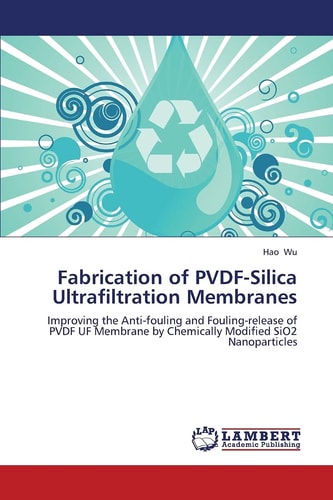
Fabrication of Pvdf-Silica Ultrafiltration Membranes
0
0
As an Amazon Associate and affiliate partner, Menrva Books earns from qualifying purchases. Learn more
Author Description
The highly hydrophobic nature of PVDF membranes makes it prone to fouling, and hydrophilic additives are frequently used to improve its wettability and fouling performance. Another approach to mitigate fouling is to alter membrane via surface modification. Under optimum conditions of membrane fabrication, in-situ membrane surface modification may be achieved as a result of the spontaneous migration of amphiphilic additives to the membrane upper surface resulting in so-called surface segregation. In this study, a novel approach was taken to use nanoparticles as carriers and anchors for antifouling ligands. Commercial SiO2 nanoparticles were chemically functionalized by silane coupling agents, which were then further used to immobilize PEG molecules on their surface. Modified nanoparticles were directly dispersed in casting solution and modified SiO2/PVDF blend membranes were prepared. The results demonstrated that the surface modified SiO2 nanoparticles acted as a carrier that facilitated the migration of PDMS or PEG molecules immobilized on SiO2 to the surface of the membrane, contributing to the modification of surface and hence improvement of the membrane fouling resistance.
Menrva's Summary
THE THESIS
This study investigates a novel method for fabricating ultrafiltration membranes with improved anti-fouling properties by incorporating surface-modified silica nanoparticles into a PVDF matrix. The research addresses the inherent hydrophobicity and fouling susceptibility of PVDF membranes, exploring the use of amphiphilic additives and surface modification techniques. The authors detail a process where commercial SiO2 nanoparticles are chemically functionalized to immobilize antifouling ligands like PEG, which are then dispersed in a casting solution to create modified SiO2/PVDF blend membranes, demonstrating enhanced fouling resistance.
THE SCOPE MAP
- Fabrication of PVDF ultrafiltration membranes using a blend approach.
- Chemical functionalization of SiO2 nanoparticles with silane coupling agents.
- Immobilization of antifouling ligands (PDMS or PEG) onto modified nanoparticles.
- In-situ membrane surface modification through nanoparticle migration.
- Evaluation of membrane fouling resistance after surface modification.
- Analysis of the role of modified nanoparticles as carriers for surface segregation.
THE AUTHORITY PERSPECTIVE
The research presents a specific technical approach to membrane fabrication, focusing on the application of modified nanoparticles to mitigate fouling. The methodology described suggests a detailed experimental investigation into material science and chemical engineering principles. The findings are likely to be of interest to researchers and engineers working in water treatment, separation technologies, and advanced materials.
Page Count:
228
Publication Date:
2013-01-01
Publisher:
Lap Lambert Academic Publishing GmbH KG
ISBN-10:
3659340529
ISBN-13:
9783659340529
Non-Fiction
Science
Nanoparticles
Chemical Engineering
Community Tags
Similar Books