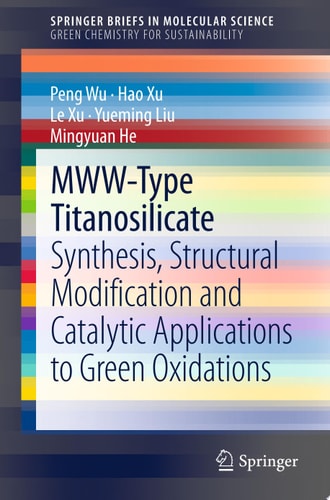
MWW-Type Titanosilicate
0
0
As an Amazon Associate and affiliate partner, Menrva Books earns from qualifying purchases. Learn more
Author Description
This book provides a comprehensive review of a new generation of selective oxidation titanosilicate catalysts with the MWW topology (Ti-MWW) based on the research achievements of the past 12 years. It gives an overview of the synthesis, structure modification and catalytic properties of Ti-MWW. Ti-MWW can readily be prepared by means of direct hydrothermal synthesis with crystallization-supporting agents, using dual-structure-directing agents and a dry-gel conversion technique. It also can be post-synthesized through unique reversible structure transformation and liquid-phase isomorphous substitution. The structural conversion of Ti-MWW into the materials usable for processing large molecules is summarized. Taking advantage of the structure diversity of the lamellar precursor of Ti-MWW, it can be fully or partially delaminated, and undergo interlayer silylation to obtain a novel structure with larger porosity. In the selective oxidation (alkene epoxidation and ketone/aldehyde ammoximation) with hydrogen peroxide or organic peroxide as an oxidant, the unique catalytic properties of Ti-MWW are described in comparison to conventional titanosilicates such as TS-1 and Ti-Beta.
Menrva's Summary
THE THESIS
This book reviews the advancements in MWW-type titanosilicate catalysts for selective oxidation reactions over the past 12 years. It details the synthesis methods, including direct hydrothermal synthesis, dual-structure-directing agents, dry-gel conversion, and post-synthesis modifications like reversible structure transformation and isomorphous substitution. The text also covers structural conversion for processing large molecules, delamination, and silylation to enhance porosity, comparing Ti-MWW's catalytic performance in alkene epoxidation and ketone/aldehyde ammoximation with conventional catalysts like TS-1 and Ti-Beta.
THE SCOPE MAP
- Overview of synthesis techniques for Ti-MWW catalysts.
- Methods for structure modification and enhancement of porosity.
- Detailed discussion of catalytic properties in selective oxidation.
- Comparison of Ti-MWW with conventional titanosilicates (TS-1, Ti-Beta).
- Applications in alkene epoxidation and ketone/aldehyde ammoximation.
- Structural conversion for processing large molecules.
- Techniques for delamination and interlayer silylation.
THE AUTHORITY PERSPECTIVE
This specialized review focuses on the synthesis, structural modification, and catalytic applications of Ti-MWW catalysts, presenting a comprehensive overview of research over a 12-year period. The text is structured to detail various preparation methods and their impact on catalytic performance, particularly in selective oxidation reactions. It offers a comparative analysis against established titanosilicate materials, providing valuable insights for researchers in catalysis and materials science. The depth of coverage suggests a resource for advanced study and development in heterogeneous catalysis.
Page Count:
125
Publication Date:
2013-08-04
Publisher:
Springer Nature
ISBN-10:
364239115X
ISBN-13:
9783642391156
Science
Non-Fiction
Chemical Engineering
Zeolites
Catalysis
Community Tags
Similar Books