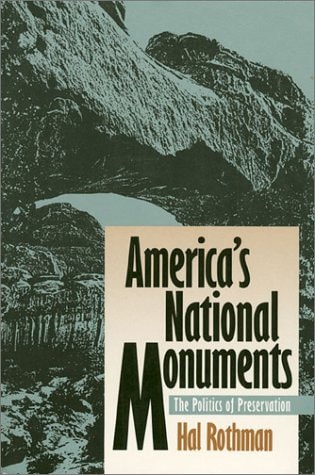
America's National Monuments: The Politics of Preservation
0
0
As an Amazon Associate and affiliate partner, Menrva Books earns from qualifying purchases. Learn more
Author Description
With the stroke of a pen, Theodore Roosevelt created the Grand Canyon National Monument in 1908. Without his quick action, commercial developers, already coveting this national treasure, would have invaded the canyon's floor. Not until eleven years later did Congress make it a national park, an act that provided funds for development and preservation unavailable to national monuments. According to Hal Rothman, the designation of national monument—decided at the discretion of the president—was the saving grace for many natural and archaeologically significant sites as debates on national park designations languished in Congress. But lacking sufficient financial backing, national monuments inevitably ended up taking a back seat to the national park system in the early twentieth century. Looking at the history of the national monuments, from the passage of the Antiquities Act of 1906—allowing for presidential designation of monuments—to the present, Rothman traces the evolution of federal preservation. He shows how laws, policies, personalities, personal and bureaucratic rivalries, and a changing cultural climate affected preservation efforts. And he illustrates how the national park system has functioned and changed over the years as public officials have tried to implement federal policy at the grassroots level. The Antiquities Act, he contends, has been undervalued and ignored by contemporary observers and historians. In fact, he demonstrates, it is the most important piece of preservation legislation ever enacted by the U.S. government. Without it, many significant sites would have been destroyed as a result of congressional inertia and indifference. Rothman examines the evolution of this vital legislation, originally designed to preserve archaeological sites in the Southwest but later also used to maintain other significant prehistoric, historic, and natural features. He explains how the act became less significant as New Deal f
Menrva's Summary
THE THESIS
The Antiquities Act of 1906 has been critically undervalued as the most important piece of U.S. preservation legislation ever enacted. Hal K. Rothman examines the history of national monuments, from the act's passage to the present, detailing how presidential discretion was crucial for preserving sites when congressional action lagged. He illustrates how laws, policies, personalities, bureaucratic rivalries, and evolving cultural attitudes have shaped preservation efforts. The book argues that without this act, many significant archaeological and natural sites would have been lost due to governmental inaction.
THE SCOPE MAP
- The historical evolution of federal preservation laws and policies in the United States.
- The role of presidential discretion versus congressional action in designating national monuments.
- Analysis of the Antiquities Act of 1906 and its impact on preserving archaeological and natural sites.
- Examination of the interplay between laws, personalities, and bureaucratic rivalries in preservation efforts.
- The changing cultural climate and its effect on the implementation of federal preservation policy.
- Comparison and contrast between the national monument and national park systems.
- The original intent of the Antiquities Act versus its later applications.
THE AUTHORITY PERSPECTIVE
This book is regarded as a significant historical analysis of U.S. preservation policy, particularly focusing on the underappreciated Antiquities Act. Rothman's work is noted for its detailed examination of the political and bureaucratic forces that have shaped the designation and management of national monuments. The book highlights the critical role of presidential action in safeguarding sites against congressional inertia and commercial interests. It serves as a comprehensive study for understanding the evolution of federal preservation efforts and the enduring importance of the Antiquities Act.
Page Count:
280
Publication Date:
1994-04-08
Publisher:
University Press of Kansas
ISBN-10:
0700606726
ISBN-13:
9780700606726
Politics
Non-Fiction
History
Preservation
Community Tags
Similar Books