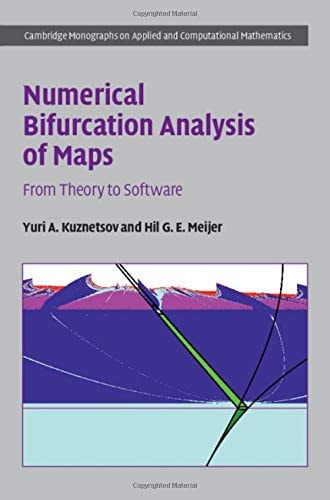
Numerical Bifurcation Analysis of Maps
0
0
As an Amazon Associate and affiliate partner, Menrva Books earns from qualifying purchases. Learn more
Author Description
This book combines a comprehensive state-of-the-art analysis of bifurcations of discrete-time dynamical systems with concrete instruction on implementations (and example applications) in the free MATLAB® software MatContM developed by the authors. While self-contained and suitable for independent study, the book is also written with users in mind and is an invaluable reference for practitioners. Part I focuses on theory, providing a systematic presentation of bifurcations of fixed points and cycles of finite-dimensional maps, up to and including cases with two control parameters. Several complementary methods, including Lyapunov exponents, invariant manifolds and homoclinic structures, and parts of chaos theory, are presented. Part II introduces MatContM through step-by-step tutorials on how to use the general numerical methods described in Part I for simple dynamical models defined by one- and two-dimensional maps. Further examples in Part III show how MatContM can be used to analyze more complicated models from modern engineering, ecology, and economics.
Menrva's Summary
THE THESIS
This book investigates the complex phenomena of bifurcations in discrete-time dynamical systems and provides practical computational tools for their analysis. The authors, experts in the field, present a systematic theoretical framework for understanding bifurcations of fixed points and cycles in finite-dimensional maps, extending to cases with multiple control parameters. Complementary methods such as Lyapunov exponents and invariant manifolds are integrated into the theoretical exposition. The work is designed to be both a self-contained study resource and a valuable reference for practitioners in scientific and engineering disciplines.
THE SCOPE MAP
- Comprehensive analysis of bifurcations in discrete-time dynamical systems.
- Detailed instruction on implementing numerical methods using MATLAB® software (MatContM).
- Step-by-step tutorials for analyzing simple dynamical models.
- Case studies demonstrating applications in modern engineering, ecology, and economics.
- Theoretical treatment of bifurcations of fixed points and cycles up to two control parameters.
- Integration of complementary methods including Lyapunov exponents and invariant manifolds.
- Introduction to relevant aspects of chaos theory.
THE AUTHORITY PERSPECTIVE
The book is presented as an invaluable reference for practitioners and a self-contained resource for independent study, combining theoretical depth with practical implementation. Its focus on bifurcations of discrete-time dynamical systems and the inclusion of the authors' MatContM software suggests a rigorous and computationally oriented approach. The application examples across engineering, ecology, and economics indicate a broad relevance for researchers and students in quantitative fields.
Page Count:
420
Publication Date:
2019-03-28
Publisher:
Cambridge University Press
ISBN-10:
1108499678
ISBN-13:
9781108499675
Non-Fiction
Economics
Science
Engineering
Numerical analysis
Dynamical Systems
Ecology
Chaos Theory
Mathematics
Community Tags
Similar Books