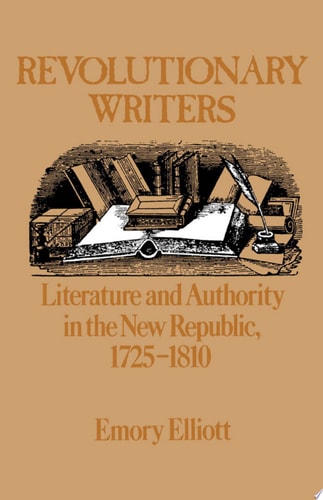
Revolutionary Writers: Literature and Authority in the New Republic, 1725-1810
0
0
As an Amazon Associate and affiliate partner, Menrva Books earns from qualifying purchases. Learn more
Author Description
Elliott demonstrates how America's first men of letters--Timothy Dwight, Joel Barlow, Philip Freneau, Hugh Henry Brackenridge, and Charles Brockden Brown--sought to make individual genius in literature express the collective genius of the American people. Without literary precedent to aid them, Elliott argues, these writers attempted to convey a vision of what America ought to be; and when the moral imperatives implicit in their writings were rejected by the vast number of their countrymen they became pioneers of another sort--the first to experience the alienation from mainstream American culture that would become the fate of nearly all serious writers who would follow.
Menrva's Summary
THE THESIS
This work investigates how early American writers attempted to define a national identity through literature and why their failure to do so led to the emergence of the alienated intellectual. Emory Elliott, a scholar of early American literature, utilizes historical analysis and close readings of key figures such as Timothy Dwight and Charles Brockden Brown to examine the intersection of political authority and creative expression. He argues that these authors sought to embody the collective spirit of the new nation, only to find themselves marginalized when their moral visions diverged from the public consensus.
THE SCOPE MAP
What You Will Find
- Analysis of the literary contributions of Timothy Dwight, Joel Barlow, Philip Freneau, Hugh Henry Brackenridge, and Charles Brockden Brown.
- Examination of the socio-political climate in America between 1725 and 1810.
- Discussion of the tension between individual artistic genius and the demands of a nascent democratic culture.
- Exploration of the origins of the alienated writer archetype in American letters.
THE AUTHORITY PERSPECTIVE
Scholars recognize this text as a significant contribution to the study of early American intellectual history and the development of the national literary canon. Readers frequently note the academic density of the prose, which provides a rigorous framework for understanding the challenges faced by the first generation of American authors.
Page Count:
334
Publication Date:
1986-02-27
Publisher:
Oxford University Press
ISBN-10:
0195039955
ISBN-13:
9780195039955
History
United States
Literary Criticism
American
Community Tags
Similar Books