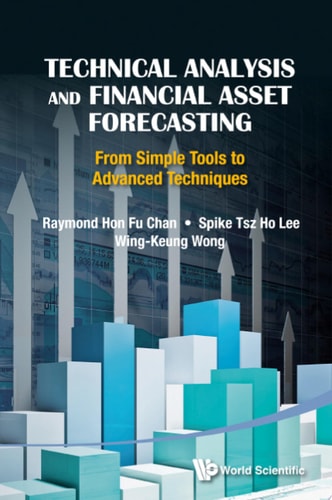
Technical Analysis and Financial Asset Forecasting: From Simple Tools to Advanced Techniques
0
0
As an Amazon Associate and affiliate partner, Menrva Books earns from qualifying purchases. Learn more
Author Description
Technical analysis is defined as the tracking and prediction of asset price movements using charts and graphs in combination with various mathematical and statistical methods. More precisely, it is the quantitative criteria used in predicting the relative strength of buying and selling forces within a market to determine what to buy, what to sell, and when to execute trades. This book introduces simple technical analysis tools like moving averages and Bollinger bands, and also advanced techniques such as wavelets and empirical mode decomposition. It first discusses some traditional tools in technical analysis, such as trend, trend Line, trend channel, Gann's Theory, moving averages, and Bollinger bands. It then introduces a recent indicator developed for stock market and two recent techniques used in the technical analysis field: wavelets and the empirical mode decomposition in financial time series. The book also discusses the theory to test the performance of the indicators and introduces the MATLAB Financial Toolbox, some of the functions/codes of which are used in our numerical experiments.
Menrva's Summary
THE THESIS
This book investigates the application of technical analysis and advanced mathematical techniques for forecasting financial asset movements. It introduces fundamental tools such as moving averages and Bollinger bands, alongside more sophisticated methods like wavelets and empirical mode decomposition. The authors detail traditional indicators and recent developments in stock market analysis, providing a comprehensive overview of quantitative criteria for predicting buying and selling forces. The text also covers performance testing theories and utilizes the MATLAB Financial Toolbox for numerical experiments.
THE SCOPE MAP
- Traditional technical analysis tools: trend, trend Line, trend channel, Gann's Theory, moving averages, and Bollinger bands.
- Recent indicators for stock market analysis.
- Advanced techniques: wavelets and empirical mode decomposition in financial time series.
- Theory and methods for testing indicator performance.
- Practical application using the MATLAB Financial Toolbox, including code examples.
THE AUTHORITY PERSPECTIVE
The book offers a structured approach to technical analysis, progressing from basic concepts to advanced mathematical methods. Its strength lies in bridging traditional charting techniques with modern signal processing tools like wavelets and empirical mode decomposition. The inclusion of MATLAB code and performance testing theories suggests a practical, research-oriented audience. The text appears designed for practitioners and academics seeking to enhance their financial forecasting capabilities through quantitative rigor.
Page Count:
204
Publication Date:
2014-01-01
Publisher:
World Scientific Publishing
ISBN-10:
9814436267
ISBN-13:
9789814436267
Economics
Non-Fiction
Science & Technology
Finance
Technical Analysis
Community Tags
Similar Books