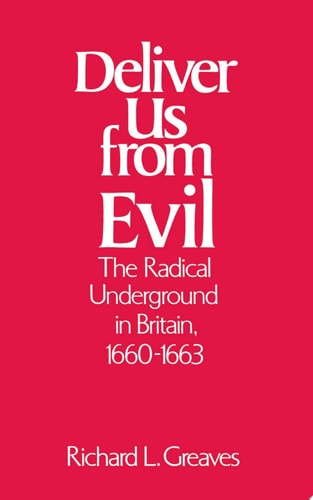
Deliver Us from Evil: The Radical Underground in Britain, 1660-1663
0
0
As an Amazon Associate and affiliate partner, Menrva Books earns from qualifying purchases. Learn more
Author Description
After more than two decades of unprecedented political, social, and religious upheaval, revolutionary thought and activity in Britain continued to thrive even after the restoration of the monarchy in 1660. This highly original study, which draws on the reports of both police and informers, follows the "radical underground" in England from the eve of the Restoration to the collapse of the northern rebellion in 1663. In a tale that winds its way across England and into Scotland, Ireland, the Netherlands, and Switzerland, Greaves examines how radicals remained united in their common animosity to monarchy, prelacy, taxes, and popery. Although ultimately unsuccessful, their conspiracies and rebellions nonetheless fueled the drive for the repression of Nonconformists, prompted the state to cultivate an elaborate network of informers, and heightened the concern for domestic security.
Menrva's Summary
THE THESIS
How did radical political and religious dissent persist and manifest in Britain during the immediate aftermath of the 1660 Restoration? Richard L. Greaves, a noted historian of the period, utilizes extensive archival research, including police reports and intelligence from state informers, to reconstruct the activities of underground groups. He argues that these radicals, despite their ultimate failure to topple the monarchy, exerted a significant influence on state policy, leading to increased surveillance and the systematic repression of Nonconformists.
THE SCOPE MAP
What You Will Find
- Analysis of radical movements in England, Scotland, Ireland, and continental Europe between 1660 and 1663.
- Examination of the state's development of an elaborate intelligence and informer network.
- Use of primary source documentation from government archives and contemporary surveillance reports.
- Exploration of the ideological motivations behind opposition to the monarchy, prelacy, and taxation.
THE AUTHORITY PERSPECTIVE
Historians recognize this work as a rigorous examination of the early Restoration period's internal security challenges. Scholars frequently cite Greaves's detailed use of informer records as a foundational methodology for understanding the state's response to political dissent.
Page Count:
302
Publication Date:
1986-05-08
Publisher:
Oxford University Press
ISBN-10:
0195039858
ISBN-13:
9780195039856
History
17th Century
Political History
British History
Religious History
Great Britain
Community Tags
Similar Books