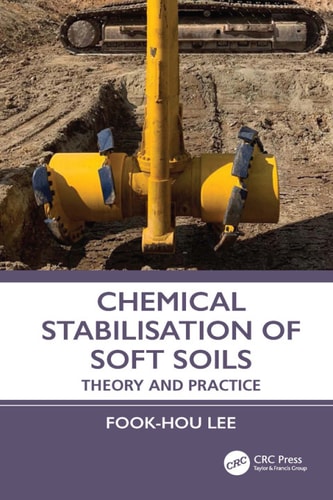
Chemical Stabilisation of Soft Soils
0
0
As an Amazon Associate and affiliate partner, Menrva Books earns from qualifying purchases. Learn more
Author Description
Chemical treatment is often used in ground engineering for the rapid stabilization of soft soil. Although different chemicals can be used, there are significant commonalities in their underlying principles and reactions. This book provides a holistic perspective on chemical stabilisation, covering its history, chemistry, factors affecting quality in the mixing processes, the properties and constitutive behaviour of improved soils, quality control, and design and construction. Uniquely, this book draws out the interrelationships between the various methods of chemical stabilisation of soils. A key example is the relation between the water content and strength, constitutive behaviour, and uniformity of mixing. Operating parameters may produce conflicting results. For instance, a high water content promotes flowability and thus miscibility, but can also result in binder-soil segregation due to density differences. Furthermore, higher water content tends to degrade the strength of the treated soil. Hence, it is important to find an optimum balance. This book is essential particularly for geotechnical engineers who are involved in the design and execution of chemical improvement of soil, as well as researchers.
Menrva's Summary
THE THESIS
This book investigates the principles and practices of chemically stabilizing soft soils for ground engineering applications. It covers the history and chemistry of various chemical stabilization methods, exploring the factors that influence the quality of mixing, the resulting properties and constitutive behavior of improved soils, and essential quality control measures. The work uniquely highlights the interrelationships between different stabilization techniques, such as the trade-offs between water content, flowability, segregation, and final soil strength, emphasizing the need for an optimal balance in operating parameters.
THE SCOPE MAP
- History and fundamental chemistry of soil stabilization using chemicals.
- Factors affecting quality during mixing processes.
- Properties and constitutive behavior of chemically improved soils.
- Quality control methods for chemical stabilization projects.
- Design and construction considerations for stabilized soils.
- Interrelationships between various chemical stabilization methods.
- Analysis of operating parameters and their potentially conflicting results (e.g., water content effects).
THE AUTHORITY PERSPECTIVE
This book is presented as essential for geotechnical engineers involved in soil improvement and for researchers in the field. The existing description highlights its comprehensive coverage and unique approach to interrelating different stabilization methods. The text aims to provide a holistic perspective, suggesting it is a valuable resource for understanding the complexities and optimization required in chemical soil stabilization.
Page Count:
0
Publication Date:
2026-03-11
Publisher:
Taylor & Francis
ISBN-10:
1040733905
ISBN-13:
9781040733905
Science & Technology
Non-Fiction
Geotechnical Engineering
Soil Science
Civil Engineering
Community Tags
Similar Books