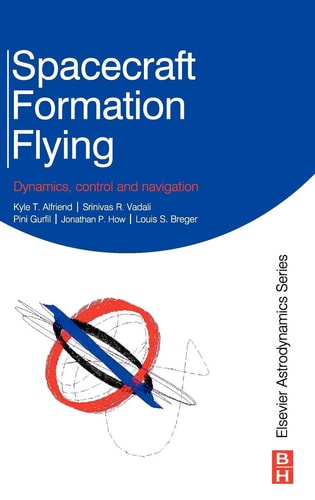
Spacecraft Formation Flying: Dynamics, Control and Navigation
0
0
As an Amazon Associate and affiliate partner, Menrva Books earns from qualifying purchases. Learn more
Author Description
Space agencies are now realizing that much of what has previously been achieved using hugely complex and costly single platform projects—large unmanned and manned satellites (including the present International Space Station)—can be replaced by a number of smaller satellites networked together. The key challenge of this approach, namely ensuring the proper formation flying of multiple craft, is the topic of this second volume in Elsevier’s Astrodynamics Series, Spacecraft Formation Flying: Dynamics, control and navigation. In this unique text, authors Alfriend et al. provide a coherent discussion of spacecraft relative motion, both in the unperturbed and perturbed settings, explain the main control approaches for regulating relative satellite dynamics, using both impulsive and continuous maneuvers, and present the main constituents required for relative navigation. The early chapters provide a foundation upon which later discussions are built, making this a complete, standalone offering. Intended for graduate students, professors and academic researchers in the fields of aerospace and mechanical engineering, mathematics, astronomy and astrophysics, Spacecraft Formation Flying is a technical yet accessible, forward-thinking guide to this critical area of astrodynamics. The first book dedicated to spacecraft formation flying, written by leading researchers and professors in the field Develops the theory from an astrodynamical viewpoint, emphasizing modeling, control and navigation of formation flying satellites on Earth orbits Examples used to illustrate the main developments, with a sample simulation of a formation flying mission included to illustrate high fidelity modeling, control and relative navigation
Menrva's Summary
THE THESIS
This book addresses the critical challenge of precisely controlling the relative motion of multiple spacecraft operating in close proximity. The authors, leading researchers in astrodynamics, present a comprehensive treatment of spacecraft formation flying, covering the underlying dynamics in both unperturbed and perturbed orbital environments. It details the primary control strategies, including impulsive and continuous maneuvers, and outlines the essential components for relative navigation. The text is structured to build foundational knowledge, making it a complete resource for its intended audience.
THE SCOPE MAP
- Detailed analysis of spacecraft relative motion dynamics.
- Explanation of control approaches using impulsive and continuous maneuvers.
- Coverage of essential elements for relative navigation.
- Examples illustrating key theoretical developments.
- A sample simulation of a formation flying mission.
- Discussion of modeling, control, and navigation for Earth orbits.
THE AUTHORITY PERSPECTIVE
This technical yet accessible guide is intended for graduate students, professors, and researchers in aerospace engineering, mathematics, and astronomy. As the first book dedicated to spacecraft formation flying, it is written by leading experts in the field. The text develops theory from an astrodynamical viewpoint, emphasizing modeling, control, and navigation. It includes illustrative examples and a sample mission simulation to demonstrate high-fidelity applications.
Page Count:
352
Publication Date:
2009-01-01
Publisher:
Elsevier S & T
ISBN-10:
0750685336
ISBN-13:
9780750685337
Non-Fiction
Science
Control systems
Astrodynamics
Aerospace Engineering
Navigation
Community Tags
Similar Books

Reader Comments
Share Your Thoughts
No comments yet. Be the first to share your thoughts!