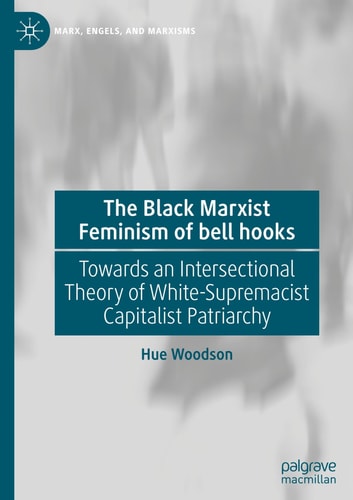
The Black Marxist Feminism of bell hooks: Towards an Intersectional Theory of White-Supremacist Capitalist Patriarchy
0
0
As an Amazon Associate and affiliate partner, Menrva Books earns from qualifying purchases. Learn more
Author Description
This book explores bell hooks' trajectory of work and cohesiveness of thought about the meaning and meaningfulness of black womanhood in terms of a Black Marxist feminism, which uniquely confronts the dimensions of feminism and womanism; the relations between the secular and the religious; the problems of gender and sexism; and the structural and systemic issues of oppression, domination, white supremacy, and capitalism. In making sense of black womanhood in its philosophical, social, cultural, institutional, and historical complexities, hooks' Black Marxist feminism constructs an intersectional theory about what hooks describes as white supremacist capitalist patriarchy. In this sense, hooks' Black Marxist feminism conceptualizes the ways and means by which white supremacist capitalist patriarchy imposes intersectional predicaments upon black womanhood, drawing foundationally on Karl Marx and Fredrich Engels, working within the purview of a host of Marxisms in Antonio Gramsci, Louis Althusser, Karl Kautsky, Nikolai Bukharin, and Georgi Plekhanov, and speaking to the Marxist proclivities of Cedric Robinson, Cornel West, Charles W. Mills, James H. Cone, Stuart Hall, and Angela Y. Davis.
Menrva's Summary
THE THESIS
This book investigates the theoretical framework of Black Marxist feminism as articulated by bell hooks and its confrontation with white supremacist capitalist patriarchy. Hue Woodson's work delves into the cohesive thought and trajectory of bell hooks' writings, specifically examining her unique approach to Black womanhood. The book analyzes how hooks' Black Marxist feminism bridges the concepts of feminism and womanism, explores the interplay between secular and religious thought, addresses issues of gender and sexism, and dissects the systemic oppressions of white supremacy and capitalism. Through this lens, it constructs an intersectional theory that illuminates the predicaments imposed upon Black womanhood by the structures of white supremacist capitalist patriarchy, drawing on a wide array of Marxist thinkers and scholars.
THE SCOPE MAP
- Exploration of bell hooks' Black Marxist feminism and its core tenets.
- Analysis of the intersectional relationship between feminism and womanism in hooks' work.
- Examination of the secular and religious dimensions within Black feminist thought.
- Discussion of gender, sexism, and their systemic implications.
- Deconstruction of white supremacy and capitalism as intersecting systems of oppression.
- Construction of an intersectional theory of white supremacist capitalist patriarchy.
- Engagement with foundational Marxist thinkers such as Karl Marx, Friedrich Engels, Antonio Gramsci, Louis Althusser, Karl Kautsky, Nikolai Bukharin, and Georgi Plekhanov.
- Dialogue with contemporary scholars including Cedric Robinson, Cornel West, Charles W. Mills, James H. Cone, Stuart Hall, and Angela Y. Davis.
THE AUTHORITY PERSPECTIVE
The book is positioned as a scholarly examination of bell hooks' contributions to Black Marxist feminism and intersectional theory. It is likely to appeal to academics and students in fields such as gender studies, sociology, critical race theory, and political philosophy. The detailed engagement with both hooks' oeuvre and a broad spectrum of Marxist and critical theorists suggests a text aimed at readers seeking a deep, analytical understanding of complex social and political structures.
Page Count:
395
Publication Date:
2024-12-28
Publisher:
Springer Nature Switzerland
ISBN-10:
3031746961
ISBN-13:
9783031746963
Non-Fiction
Philosophy
Patriarchy
Feminism
Social Theory
Black studies
Intersectionality
Marxism
Community Tags
Similar Books