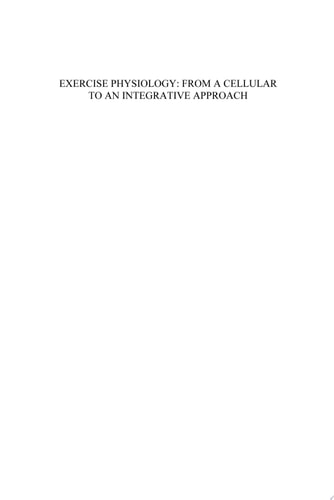
Exercise Physiology: From a Cellular to an Integrative Approach
0
0
As an Amazon Associate and affiliate partner, Menrva Books earns from qualifying purchases. Learn more
Author Description
There is no doubt that if the field of exercise physiology is to make further advancements, the various specialized areas must work together in solving the unique and difficult problems of understanding how exercise is initiated, maintained and regulated at many functional levels, and what causes us to quit. Exercise is perhaps the most complex of physiological functions, requiring the coordinated, integrated activation of essentially every cell, tissue and organ in the body. Such activation is known to take place at all levels - from molecular to systemic. Focusing on important issues addressed at cellular and systemic levels, this handbook presents state-of-the-art research in the field of exercise physiology. Each chapter serves as a comprehensive resource that will stimulate and challenge discussion in advanced students, researchers, physiologists, medical doctors and practitioners. Authored by respected exercise physiologists from nineteen countries, each chapter has been significantly updated to provide up-to-date coverage of the topics and to offer complete descriptions of the many facets of the most physiological responses from a cellular to an integrative approach within individual body systems in normal and disease states and includes some chapters that are rarely addressed in exercise physiology books, such as the influence of exercise on endothelium, vasomotor control mechanisms, coagulation, immune function and rheological properties of blood, and their influence on hemodynamics. This book represents the first iteration to provide such a work. Normal exercise responses divided into muscle function, bioenergetics, and respiratory, cardiac and blood/vascular function; Fitness, training, exercise testing and limits to exercise; Exercise responses in different environments; Beneficial effects of exercise rehabilitation on ageing and in the prevention and treatment of disease states; Rarely addressed issues such as the influence of exercise on endothelium, v
Menrva's Summary
THE THESIS
This handbook investigates the complex physiological responses to exercise, from the molecular level to systemic integration.
Authored by respected exercise physiologists from nineteen countries, this work presents state-of-the-art research in exercise physiology, focusing on issues addressed at cellular and systemic levels. It aims to provide a comprehensive resource for advanced students, researchers, medical doctors, and practitioners, stimulating discussion on how exercise is initiated, maintained, and regulated, and what factors lead to cessation. The book covers normal exercise responses in muscle function, bioenergetics, and respiratory, cardiac, and blood/vascular systems, as well as fitness, training, exercise testing, and limits to exercise.
THE SCOPE MAP
- Normal exercise responses divided into muscle function, bioenergetics, and respiratory, cardiac and blood/vascular function
- Fitness, training, exercise testing and limits to exercise
- Exercise responses in different environments
- Beneficial effects of exercise rehabilitation on ageing and in the prevention and treatment of disease states
- Rarely addressed issues such as the influence of exercise on endothelium, vasomotor control mechanisms, coagulation, immune function and rheological properties of blood, and their influence on hemodynamics
- Coverage of exercise responses in normal and disease states
THE AUTHORITY PERSPECTIVE
This handbook is presented as a comprehensive resource for advanced students, researchers, medical doctors, and practitioners, aiming to stimulate discussion on complex physiological responses to exercise. The collection of research from nineteen countries suggests a broad scope and international perspective on the field. Its inclusion of rarely addressed topics indicates an effort to expand the typical discourse within exercise physiology. The book is structured to offer up-to-date coverage and detailed descriptions of physiological responses across various body systems.
Page Count:
673
Publication Date:
2010-01-01
Publisher:
IOS Press
ISBN-10:
1607504960
ISBN-13:
9781607504962
Non-Fiction
Science
Medical research
Sports Science
Community Tags
Similar Books

Reader Comments
Share Your Thoughts
No comments yet. Be the first to share your thoughts!