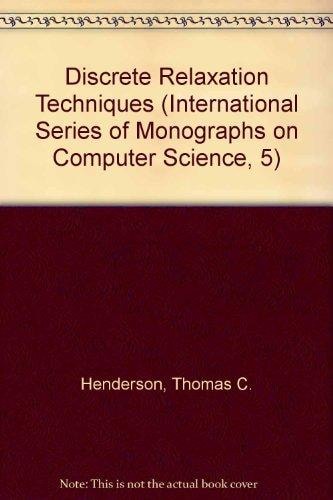
Discrete Relaxation Techniques
0
0
As an Amazon Associate and affiliate partner, Menrva Books earns from qualifying purchases. Learn more
Author Description
Relaxation techniques are iterative methods of solving systems of equations by successive approximations that lead ultimately to a minimization of the difference between the solution and "reality." One important application of this method lies in image processing, when, given incomplete, ambiguous information, a computer attempts to determine the nature of an object and its orientation in three dimensions. An invaluable resource for computer scientists and electrical engineers, this book provides a firm foundation in these techniques and discusses its applications in computer vision and artificial intelligence.
Menrva's Summary
THE THESIS
This text investigates the application of discrete relaxation techniques as a computational method for resolving systems of equations to interpret ambiguous or incomplete data. Thomas C. Henderson, a researcher in computer science, synthesizes mathematical iterative methods with practical implementations in machine perception. The book establishes a formal framework for how successive approximations can minimize error in complex systems, specifically focusing on the challenges inherent in three-dimensional object recognition and spatial orientation. By bridging theoretical numerical analysis with applied engineering, the author provides a structured approach to solving problems where information is inherently noisy or sparse.
THE SCOPE MAP
What You Will Find
- Mathematical foundations of iterative relaxation methods for system optimization.
- Algorithmic approaches to resolving incomplete or ambiguous data sets in computer vision.
- Case studies demonstrating the application of relaxation in artificial intelligence and image processing.
- Methodologies for determining object identity and orientation within three-dimensional space.
THE AUTHORITY PERSPECTIVE
Experts identify this work as a specialized monograph that serves as a foundational reference for researchers in early computer vision and pattern recognition. Readers frequently note the technical density of the prose, which requires a strong background in linear algebra and computational theory to fully grasp the presented algorithms.
Page Count:
160
Publication Date:
1989-12-14
Publisher:
Oxford University Press
ISBN-10:
0195048946
ISBN-13:
9780195048940
Computer Science
Image Processing
Mathematics
Computer Vision
Integrated Circuits
Community Tags
Similar Books