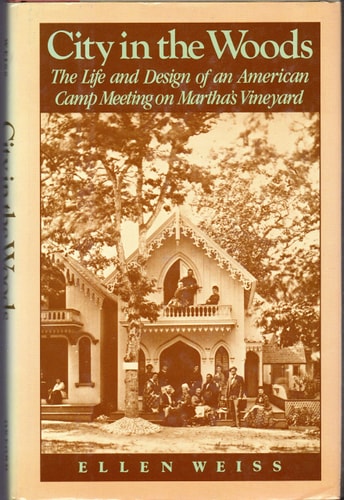
City in the Woods: The Life and Design of an American Camp Meeting on Martha's Vineyard
0
0
As an Amazon Associate and affiliate partner, Menrva Books earns from qualifying purchases. Learn more
Author Description
The Wesleyan Grove Methodist camp meeting, founded on the island of Martha's Vineyard, had become by 1860 the most famous in the nation. Around this time, local carpenters invented a new building, the campground cottage, in which architectural allusions to tents, houses, and churches were combined into a sophisticated and memorable form, now often referred to as the "gingerbread house." The peculiar natures of the cottages were made further unique by their arrangement on the land--they sit cheek to jowl on tiny lots with virtually no private outdoor space, facing directly onto public paths or small parks. Wesleyan Grove astonished tourists, who saw it as an exoticism, a "fairyland" with a better society than the norm. In 1866 developers bought the adjacent land to lay out a resort, Oak Bluffs, planning the style in reponse to the campground configuration. In City in the Woods, Ellen Weiss describes the development of these fanciful architectural oddities and suggests that Wesleyan Grove must be included among the sources of the American romantic suburb. The values inherent in this campground community--a physical environment of psychic dislocation, social density, and nature immersion--add to a better understanding of the American urge to live in the suburbs. This beautifully written work includes over forty photographs which depict the charm, grace, and meticulous preservation of one of the most prominent historical New England communities.
Menrva's Summary
THE THESIS
This work investigates the architectural evolution and social significance of the Wesleyan Grove Methodist camp meeting on Martha's Vineyard as a foundational influence on the American romantic suburb. Ellen Weiss, an architectural historian, utilizes primary historical records, site plans, and visual documentation to argue that the unique "gingerbread" cottage design and dense communal layout of the campground reflect broader American cultural aspirations regarding nature, social density, and domestic space. By tracing the transition from a religious retreat to the resort community of Oak Bluffs, the author provides a framework for understanding how these specific spatial arrangements informed later suburban development patterns.
THE SCOPE MAP
What You Will Find
- Historical analysis of the Wesleyan Grove Methodist camp meeting development from 1860 onward.
- Examination of the architectural transition from tent-based structures to permanent "gingerbread" cottages.
- Comparative study of the campground layout versus the adjacent Oak Bluffs resort planning.
- Discussion of the sociological implications of high-density communal living in a nature-focused environment.
THE AUTHORITY PERSPECTIVE
Experts and architectural historians frequently cite this work as a definitive study on the intersection of religious history and vernacular American architecture. Readers often note the clarity of the prose and the effectiveness with which the author connects specific local building styles to national trends in suburban planning.
Page Count:
186
Publication Date:
1987-05-07
Publisher:
Oxford University Press
ISBN-10:
0195041631
ISBN-13:
9780195041637
History
Architecture
urban planning
New England
Social History
Community Tags
Similar Books