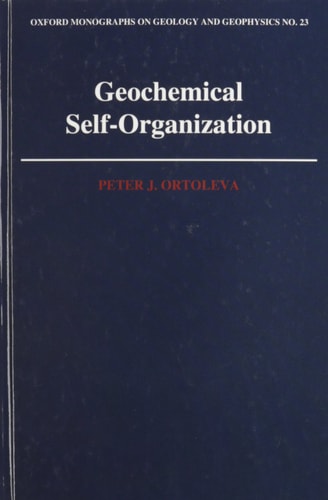
Geochemical Self-Organization
0
0
As an Amazon Associate and affiliate partner, Menrva Books earns from qualifying purchases. Learn more
Author Description
This monograph offers an interdisciplinary approach to the analysis of geological systems which become spatially organized through the mediation of chemical processes. The treatment is based on a mathematical approach. The intended readership includes researchers and advanced undergraduate and graduate students in all branches of geology as well as scientists and mathematicians concerned with nonlinear dynamics, numerical analysis, self-organization, nonlinear waves and dynamics, and phase transition phenomena. The work could also serve as a basis for a special topics course in mathematics, chemistry or physics.
Menrva's Summary
THE THESIS
This monograph investigates the mechanisms by which geological systems achieve spatial organization through the interaction of chemical processes and physical dynamics. Peter J. Ortoleva, a recognized expert in the field, utilizes a rigorous mathematical framework to model how nonlinear dynamics influence the formation of geological structures. The text bridges the gap between theoretical chemistry and geophysical observation, providing a structured approach to understanding complex phase transitions in the Earth's crust. By applying numerical analysis to chemical kinetics, the author establishes a foundation for predicting the evolution of self-organizing geological systems.
THE SCOPE MAP
What You Will Find
- Mathematical modeling of nonlinear chemical waves and dynamics in geological environments
- Analysis of phase transition phenomena within mineralogical systems
- Theoretical frameworks for understanding spatial pattern formation in rock formations
- Numerical methods for simulating geochemical self-organization processes
THE AUTHORITY PERSPECTIVE
Experts identify this work as a foundational text for researchers and advanced students interested in the intersection of geology and nonlinear dynamics. Readers frequently note the high level of mathematical density, which requires a strong background in calculus and physical chemistry to fully comprehend the presented models.
Page Count:
432
Publication Date:
1994-09-08
Publisher:
Oxford University Press
ISBN-10:
0195044762
ISBN-13:
9780195044768
Science
Nonlinear Dynamics
Mathematics
Chemistry
Geology
Geophysics
Community Tags
Similar Books