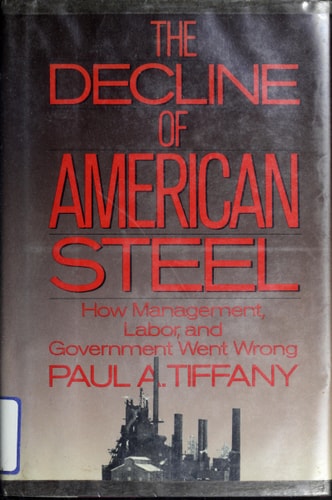
The Decline of American Steel: How Management, Labor, and Government Went Wrong
0
0
As an Amazon Associate and affiliate partner, Menrva Books earns from qualifying purchases. Learn more
Author Description
Once the great symbol of American industrial strength, the steel industry by 1960 had begun its fall to a position of confusion and weakness, while its leading off-short competitors--primarily Germany and Japan--were surging into the world market. Most accounts of this shocking fall have focused on the short-sightedness of steel executives. But in The Decline of American Steel, Paul Tiffany offers a much broader perspective on the post-World War II steel industry, identifying the long-standing antagonism among steelmakers, government, and labor as the root of this industry's decline.Focusing in particular on the crucial interval from 1945 to 1960, Tiffany finds that a combination of public policy failure, excessive labor demands, and management shortcomings accounted for the industry's subsequent problems. Immediately after the war, the Truman administration, worried about what it believed would be pent up demand for steel, pressured the steel producers to expand capacity by building new mills. The industry was skeptical about increased demand and only reluctantly took the less expensive "rounding out" approach (adding on to existing mills), instead of the more costly and time-consuming "greenfield" approach (building mills from scratch). As a result, the industry was saddled with obsolete mills and could not compete effectively with Germany or Japan. The leaders of the United Steel Workers union were equally short-sighted, says Tiffany, particularly during the disasterous strike of 1959, which permanently opened the doors to foreign steel.Neither steel managers, nor union leaders, nor several Administrations escape blame in this study. If they had worked together, Tiffany argues, the industry might have maintained its dominant position in the world market. Instead, they provide a valuable lesson for executives, union leaders, and politicians involved in any aspect of the national economy.
Menrva's Summary
THE THESIS
This book investigates the systemic factors that led to the decline of the American steel industry from its post-World War II dominance to its mid-century state of industrial weakness. Paul A. Tiffany, an expert in industrial management and history, utilizes a comprehensive analysis of the period between 1945 and 1960 to challenge the narrative that executive short-sightedness was the sole cause of the industry's failure. He argues that the collapse resulted from a toxic, long-standing antagonism between corporate management, labor unions, and federal government policy, which collectively prevented necessary modernization and strategic investment.
THE SCOPE MAP
What You Will Find
- A detailed examination of the post-WWII economic landscape and the specific impact of the 1959 steel strike.
- A comparative analysis of the 'rounding out' versus 'greenfield' mill expansion strategies.
- Primary source evidence documenting the interactions between the Truman administration and steel producers.
- An assessment of how labor union demands and public policy failures contributed to the loss of global market share to Germany and Japan.
THE AUTHORITY PERSPECTIVE
Experts recognize this work as a critical, multi-dimensional analysis of American industrial decline that moves beyond simplistic blame-shifting. Readers frequently note the academic rigor of the text, which provides a foundational understanding of how institutional friction can undermine national economic competitiveness.
Page Count:
304
Publication Date:
1988-05-05
Publisher:
Oxford University Press
ISBN-10:
0195043820
ISBN-13:
9780195043822
Business
Economics
History
Labor Relations
Public Policy
Industrial history
Community Tags
Similar Books