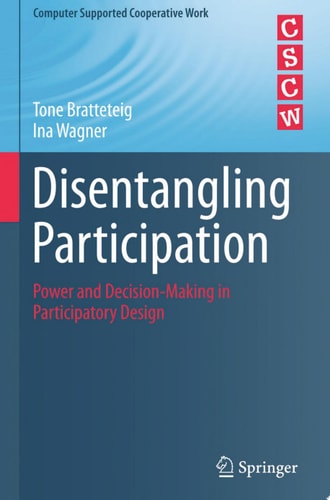
Disentangling Participation
0
0
As an Amazon Associate and affiliate partner, Menrva Books earns from qualifying purchases. Learn more
Author Description
Providing a critical view on user participation in design, disentangling decision making and power in design, this book uses fieldwork material from two large participatory design projects: one experimental in the field of urban planning, the other a product development project within health care. Addressing power issues in participatory design is critical to providing a realistic view of the possibilities and limitations of participation. Design is decision-making: during a design process a huge number of decisions taken before the designers end up with a design result - an artefact or system. All decisions are a choice between possibilities and selecting one of them and making it concrete as a change in an artefact is a demonstration of the capacity to transform, which is a key aspect of power. Participatory designers are committed to empowering users and facilitating a design process where users are able to take part in all types of decisions. This volume explores the challenges for practitioners of participatory design arising from this commitment by asking what participation really means: who should participate and in which parts of a design process; what does it mean to share power with users; how are decisions to be made in a participatory way and what is it that users participate in? The book provides a conceptual framework for understanding these issues as well as a fresh look at participation.
Menrva's Summary
THE THESIS
This book critically examines the complexities of user participation in design processes, focusing on the inherent power dynamics and decision-making structures. It analyzes two large participatory design projects, one in urban planning and another in healthcare, to explore the practical challenges faced by designers committed to empowering users. The authors investigate what genuine participation entails, who should be involved, how power can be shared, and the very nature of user involvement in transforming artifacts and systems.
THE SCOPE MAP
- Analysis of decision-making and power dynamics in participatory design.
- Fieldwork material from two large-scale projects: urban planning and healthcare product development.
- A conceptual framework for understanding participation and power in design.
- Exploration of the challenges practitioners face in empowering users.
- Discussion on the meaning of participation, user involvement, and decision-making processes.
- A fresh perspective on the possibilities and limitations of user participation.
THE AUTHORITY PERSPECTIVE
This volume offers a critical examination of user participation in design, drawing on empirical data from two distinct projects. The authors' focus on disentangling decision-making and power dynamics provides a nuanced perspective on the realities of participatory design. The book is structured to offer both a theoretical framework and practical insights for designers and researchers interested in the complexities of user involvement. Its detailed case studies and analytical approach suggest it is a valuable resource for understanding the challenges and potential of empowering users in design.
Page Count:
118
Publication Date:
2014-08-07
Publisher:
Springer Nature
ISBN-10:
3319061631
ISBN-13:
9783319061634
Non-Fiction
Science
Sociology
Design
urban planning
Healthcare
Research Methods
Community Tags
Similar Books