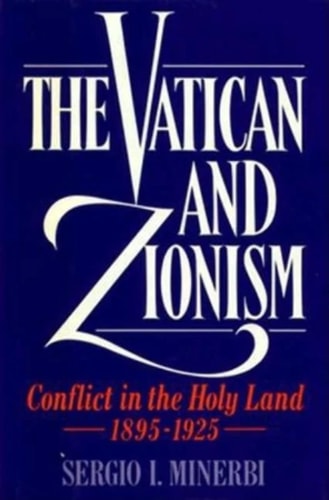
The Vatican and Zionism: Conflict in the Holy Land, 1895-1925
0
0
As an Amazon Associate and affiliate partner, Menrva Books earns from qualifying purchases. Learn more
Author Description
It seems odd that today, as the nations of Eastern Europe restore diplomatic ties to Israel, the Vatican still refuses to have normal relations with it. But, as Sergio Minerbi writes in this fascinating account, the Papacy has been consistently hostile to Zionism since before the First World War.Drawing on many unpublished documents from diplomatic archives, Minerbi brings to light the little-known role of the Vatican in relation both to the Great Powers and the Zionists in the early years of the twentieth century. Engaged in a complex balancing act involving the Ottoman rulers of Palestine, rival Christian churches (both Eastern Orthodox and Protestant), and the conflicting claims of Catholic countries with regard to the Protectorate over the Holy Places, the Vatican looked with dismay on the possibility of a Protestant British mandate--especially after the 1917 Balfour Declaration, which declared Whitehall's sympathy with Zionist aspirations. To the Vatican, a British mandate was disturbing, but a Jewish state was anathema.Vatican opposition to the formation of a Jewish homeland stemmed largely from traditional Christian anti-Semitism, which in modern times took the form of an equation of Zionism with Bolshevism, and ancient theological doctrines regarding Judaism. In 1904, the Zionist leader Theodor Herzl obtained an audience with Pope Pius X in the hope of persuading the pontiff to support the establishment of a Jewish homeland in Palestine. Herzl's hopes were dashed: the Pope's response to his requests was "Non possumus"--"We cannot." In 1917 Pius X's successor, Pope Benedict XV, received a later Zionist leader, Nahum Sokolow, with more courtesy, but displayed an equally sturdy refusal to support a Jewish state. The Zionists, who had pronounced themselves ready to respect the sanctity of the Holy Places, mistakenly believed that the Vatican would be satisfied with control over individual sites, rather than territory.The Vatican's bid for control over the territ
Menrva's Summary
THE THESIS
This work investigates the historical origins and theological motivations behind the Vatican's persistent opposition to the Zionist movement during the formative years of the early twentieth century. Sergio I. Minerbi, a scholar of diplomatic history, utilizes previously unpublished documents from Vatican archives to reconstruct the complex geopolitical landscape of the Holy Land between 1895 and 1925. He argues that the Papacy's stance was driven by a combination of traditional theological doctrine, concerns over the status of Holy Places, and a strategic fear of Protestant British influence in the region.
THE SCOPE MAP
What You Will Find
- Analysis of diplomatic relations between the Holy See, the Ottoman Empire, and the British Mandate authorities.
- Examination of the 1904 meeting between Theodor Herzl and Pope Pius X.
- Documentation of the Vatican's internal policy shifts regarding the Balfour Declaration.
- Exploration of the intersection between anti-Semitism and the political equation of Zionism with Bolshevism.
THE AUTHORITY PERSPECTIVE
Scholars and historians recognize this text as a significant contribution to the study of twentieth-century ecclesiastical diplomacy. Readers frequently note the academic density of the prose and the author's meticulous use of primary source archives to substantiate his claims.
Page Count:
272
Publication Date:
1990-11-15
Publisher:
Oxford University Press
ISBN-10:
0195058925
ISBN-13:
9780195058925
Religion
History
Jewish History
Diplomatic History
Catholic Church
Community Tags
Similar Books