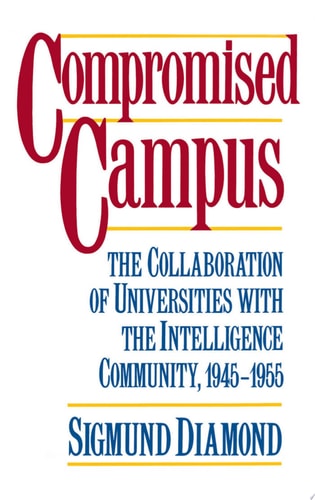
Compromised Campus: The Collaboration of Universities with the Intelligence Community, 1945-1955
0
0
As an Amazon Associate and affiliate partner, Menrva Books earns from qualifying purchases. Learn more
Author Description
In the early 1950s, a young Harvard professor named Henry Kissinger approached the FBI with alleged evidence of communist subversion among the foreign students of his summer seminar. His evidence was a flyer criticizing the nuclear arms build-up and promoting world peace. At the same time at Yale, young William F. Buckley, Jr., was discovering more than God while writing God and Man at Yale as an undergraduate. He was discovering J. Edgar Hoover. These are just two examples of how ambitious young men used the "special relationship" developing between the FBI and the universities to advance their fledgling careers. Revelations such as these abound in Sigmund Diamond's Compromised Campus, an eye-opening look at the role American intelligence agencies played at some of America's most prestigious universities.It is often said that in the 1950s, American universities were free of the McCarthyism that pervaded the rest of the nation. Not so, says Diamond. Using previously secret materials newly made available under the Freedom of Information Act, and an impressive amount of information gained from years of research in university and foundation archives, he reveals that despite academia's "official story" of autonomy from the federal government, in fact university administrators, faculty, and students secretly and actively sought close ties with intelligence agencies. Diamond describes the cooperation of Harvard President James B. Conant with intelligence agencies, the institution and operation of Harvard's Russian Research Center, Yale's shadowy "liaison agent" H.B. Fisher, who moved from problems of student drinking to cooperation with the FBI in loyalty-security matters, and the existence of formal and informal relations with the FBI and other intelligence agencies at major universities throughout the country. He calls attention to the cooperation of university presidents--Griswold of Yale, Dodds of Princeton, Wriston of Brown, Sproul of California, among others--with t
Menrva's Summary
THE THESIS
This work investigates the extent to which American universities actively collaborated with intelligence agencies during the early Cold War period, challenging the prevailing narrative of academic autonomy. Sigmund Diamond, a professor of sociology, utilizes declassified FBI files obtained through the Freedom of Information Act alongside extensive archival research from university and foundation records. He argues that university administrators, faculty, and students frequently sought and maintained clandestine relationships with federal intelligence services to advance institutional and personal interests. The text systematically dismantles the myth that academia remained a sanctuary from the pervasive McCarthyism of the 1950s.
THE SCOPE MAP
What You Will Find
- Analysis of the 1945-1955 period regarding the intersection of higher education and federal surveillance.
- Documentation of specific administrative and faculty liaisons at institutions including Harvard, Yale, Princeton, and Brown.
- Primary source evidence derived from Freedom of Information Act requests and private university archives.
- Examination of the institutionalization of intelligence cooperation through research centers and formal reporting channels.
THE AUTHORITY PERSPECTIVE
Scholars and historians recognize this text as a significant contribution to the study of Cold War domestic policy and the erosion of academic freedom. Readers frequently note the dense, evidence-heavy nature of the prose, which serves as a foundational critique of the relationship between the state and the ivory tower.
Page Count:
384
Publication Date:
1992-06-18
Publisher:
Oxford University Press
ISBN-10:
0195053826
ISBN-13:
9780195053821
History
Intelligence
Cold War
Education
Community Tags
Similar Books