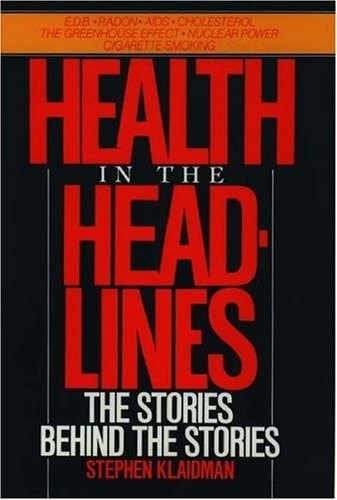
Health in the Headlines: The Stories Behind the Stories
0
0
As an Amazon Associate and affiliate partner, Menrva Books earns from qualifying purchases. Learn more
Author Description
Reporting on health risks is rarely simple and straightforward. Scientific findings are often complex and ambiguous. Even researchers may disagree on their import. Relatively few journalists have special training in science or medicine. Sources of information are often biased, and there is constant pressure to convert dry, technical material into compelling, readable stories. No wonder reporters sometimes exaggerate or otherwise misinterpret the risks, or overemphasize the emotional side of scientific stories, or unwittingly introduce inaccuracies or make important omissions. All this leaves us--the newspaper reader or TV viewer--with many unanswered questions: Is borderline cholesterol a significant health risk? Has global warming already started? Is Alar a serious threat? Is it really dangerous to live near a nuclear reactor?In Health in the Headlines, Stephen Klaidman illuminates the tangle of science, politics, and economics that often obscures health reporting, focusing on seven major stories: EDB, radon, nuclear power, the greenhouse effect, AIDS, cholesterol, and smoking. In each section, Klaidman vividly recounts how the story developed and evaluates how the press performed. In the chapter on AIDS, for instance, he traces the story from the first reports by the CDC and the early articles by The Los Angeles Times and The New York Times, to the dramatic increase in coverage following Rock Hudson's death. Klaidman finds that the science coverage of the AIDS crisis was highly competent, but the coverage of the human story and especially the political story (the Reagan Administration's inadequate funding of AIDS research, despite calling it their "number one health priority") was generally poor--on the rare occasion when they covered the story at all, most reporters uncritically accepted the Administration's side over that of AIDS activists (who were predominantly gay). Throughout the book, Klaidman provides illuminating insights into health-care reporting and he
Menrva's Summary
THE THESIS
How does the intersection of scientific complexity, political pressure, and media constraints influence the public perception of health risks? Stephen Klaidman, a veteran journalist, examines the systemic challenges reporters face when translating technical medical and scientific data into accessible news. By analyzing the performance of major media outlets, he argues that the pressure to create compelling narratives often leads to the distortion of scientific facts and the neglect of critical political context.
THE SCOPE MAP
What You Will Find
- Case studies of seven major health and environmental stories including AIDS, radon, and the greenhouse effect.
- An evaluation of journalistic methodology regarding the interpretation of scientific data.
- Analysis of how political agendas and economic interests shape public health reporting.
- A critique of the balance between human-interest storytelling and objective scientific reporting.
THE AUTHORITY PERSPECTIVE
Experts and media scholars frequently cite this work as a foundational text for understanding the pitfalls of science journalism. Readers often note the clarity with which Klaidman dissects the tension between technical accuracy and the demands of the news cycle.
Page Count:
264
Publication Date:
1991-09-12
Publisher:
Oxford University Press
ISBN-10:
0195052986
ISBN-13:
9780195052985
Science
Health
Non-Fiction
Journalism
United States
Media Studies