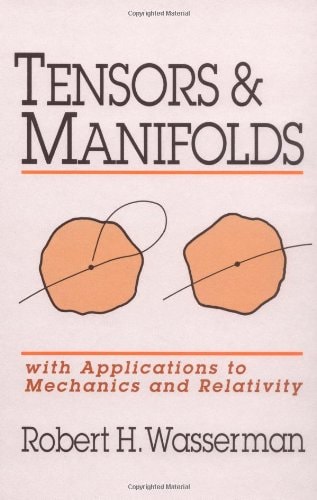
Tensors and Manifolds: With Applications to Mechanics and Relativity
0
0
As an Amazon Associate and affiliate partner, Menrva Books earns from qualifying purchases. Learn more
Author Description
This book introduces the concepts of tensor algebras and differentiable manifolds to the intermediate-level student. It describes analytical and geometrical structures built on these basic concepts. Those structures -- which include differential forms and their integration, flows, Lie derivatives, distributions and their integrability conditions, connections, and pseudo-Riemannian and symplectic manifolds -- are then applied to the description of the fundamental ideas and Hamiltonian and Lagrangian mechanics, and special and general relativity. This book is designed to be accessible to the mathematics or physics student with a good standard undergraduate background, who is interested in obtaining a broader perspective of the rich interplay of mathematics and physics before deciding on a specialty.
Menrva's Summary
THE THESIS
This text investigates the mathematical foundations of tensor algebra and differentiable manifolds to provide a bridge between abstract geometry and physical applications. Robert H. Wasserman utilizes his background in mathematical physics to construct a framework that connects analytical structures with the physical laws governing mechanics and relativity. The book serves as a pedagogical tool for students seeking to understand the rigorous interplay between geometric theory and its utility in modeling physical systems.
THE SCOPE MAP
What You Will Find
- Comprehensive coverage of tensor algebras and differentiable manifolds.
- Detailed examination of differential forms, Lie derivatives, and integration techniques.
- Application of geometric structures to Hamiltonian and Lagrangian mechanics.
- Theoretical exploration of pseudo-Riemannian and symplectic manifolds in the context of special and general relativity.
THE AUTHORITY PERSPECTIVE
Experts identify this work as a bridge for intermediate students transitioning from undergraduate calculus to advanced theoretical physics. Readers frequently note the technical density of the prose, which requires a solid foundation in undergraduate mathematics to navigate effectively.
Page Count:
424
Publication Date:
1992-07-30
Publisher:
Oxford University Press
ISBN-10:
0195065611
ISBN-13:
9780195065619
Physics
Mathematics
Mathematical Physics
textbook
Mechanics
Differential Geometry
Relativity
Community Tags
Similar Books