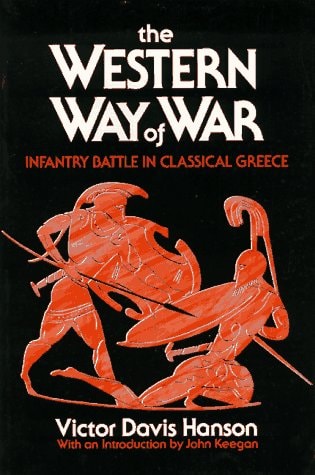
The Western Way of War: Infantry Battle in Classical Greece
0
0
As an Amazon Associate and affiliate partner, Menrva Books earns from qualifying purchases. Learn more
Author Description
The origins of Western warfare lie in classical Greece, on the battlefields of Marathon and Delion, and in the strange, terrible head-on collision of Thebans and Spartans at Koroneia. Instead of the ambush, skirmish, or single combat between heroes, the Greeks of the classical age devised a ferocious, brutal, brief, and very destructive form of combat that used armed men of all ages. With this technique, they invented the central act of Western warfare--the decisive infantry battle.In this bold and original study, Victor Davis Hanson presents a new interpretation of Greek warfare and what took place on the battlefield. He argues that the same concept that shaped democracy--an unequivocal, instant resolution to dispute--also spawned the horrific nature of hoplite phalanx battles, and that Western culture may have learned the wrong lessons from them.The Western Way of War draws from an extraordinary range of sources--Greek poetry, drama, and vase painting, as well as historical records--to fashion the first dramatic narrative of the actual mechanics of classical Greek warfare. Approaching his subject from the vantage point of the infantryman, Hanson explores everything from the brutal spear-thrusting and shield-pushing in the phalanx, and the difficulty of fighting in bronze armor, to the mass panic and hysteria. He describes the physical condition and age of the men and their commanders, their weapons, their capabilities, their spirit and morale, and their wounds; and covers the social and political aspects of the soldier's experience, revealing how profoundly the simple, brief, and brutal misery of infantry battle defined a man's entire relationship with his family, his community, and his country.Hanson's compelling account of what happened on the killing fields of the ancient Greeks raises new issues and questions old assumptions about the raison d'être for war.
Menrva's Summary
THE THESIS
This work investigates whether the specific cultural and political structures of classical Greece directly necessitated the development of the decisive, brutal infantry battle as the primary mode of Western warfare. Victor Davis Hanson, a classicist and military historian, utilizes a multidisciplinary approach to analyze the physical and psychological realities of the hoplite phalanx. He argues that the Greek commitment to immediate, unequivocal resolution in both democratic governance and military engagement created a unique, destructive paradigm that has influenced Western combat for centuries.
THE SCOPE MAP
What You Will Find
- Analysis of the hoplite phalanx mechanics, including spear-thrusting and shield-pushing techniques.
- Examination of the physical and psychological toll on infantrymen, including combat fatigue and mass panic.
- Integration of diverse primary sources, ranging from Greek poetry and drama to vase paintings and historical records.
- Exploration of the intersection between ancient Greek social structures, democratic ideals, and the nature of battlefield violence.
THE AUTHORITY PERSPECTIVE
Scholars and military historians frequently cite this text as a foundational study for understanding the visceral reality of ancient combat. Readers often note the author's ability to bridge the gap between high-level political theory and the granular, often gruesome, experience of the individual soldier.
Page Count:
272
Publication Date:
1990-11-29
Publisher:
Oxford University Press
ISBN-10:
0195065883
ISBN-13:
9780195065886
History
Warfare
Military History
Military Science
History Military
Ancient Greece
Community Tags
Similar Books