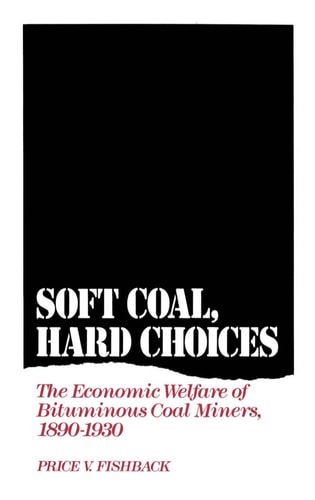
Soft Coal, Hard Choices: The Economic Welfare of Bituminous Coal Miners, 1890-1930
0
0
As an Amazon Associate and affiliate partner, Menrva Books earns from qualifying purchases. Learn more
Author Description
While most studies of labor in the coal industry focus on the struggle to organize unions, this work offers a more diverse and quantitative examination of the labor market. It regards the economic lives of the bituminous coal miners in the early twentieth century. Fishback's analytic framework encompasses competition among employers for labor, the legal environment, institutional development in response to transactions costs as well as the impact of labor unions on the coal industry. Utilizing economic theory and statistics, Fishback reveals the models hidden in the descriptions of events, and then tests their internal consistency as well as the hypotheses they generate.
Menrva's Summary
THE THESIS
This work investigates the economic welfare and labor market dynamics of bituminous coal miners in the United States between 1890 and 1930. Price V. Fishback, an economist, utilizes a rigorous quantitative framework to move beyond traditional union-centric narratives of the coal industry. By applying economic theory to historical data, the author examines how competition, institutional development, and legal environments shaped the material conditions of miners during this period of industrial expansion.
THE SCOPE MAP
What You Will Find
- Quantitative analysis of labor market competition among coal employers.
- Examination of institutional responses to transaction costs in mining communities.
- Evaluation of the impact of labor unions on industry-wide wage and welfare structures.
- Statistical testing of economic models against historical event data.
THE AUTHORITY PERSPECTIVE
Economists and historians frequently cite this work for its disciplined application of quantitative methods to labor history. Experts highlight the text as a foundational resource for understanding the complex economic incentives that governed early twentieth-century industrial labor.
Page Count:
296
Publication Date:
1992-05-28
Publisher:
Oxford University Press
ISBN-10:
0195067258
ISBN-13:
9780195067255
Economics
History
Labor
Industrial history
Coal Miners
Community Tags
Similar Books