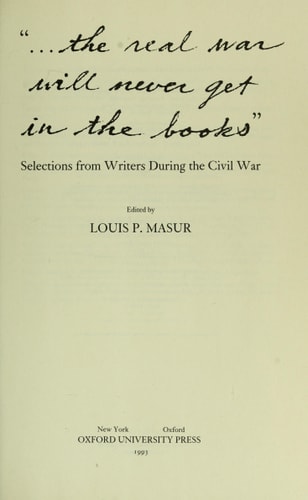
... The Real War Will Never Get In the Books: Selections from Writers During the Civil War
0
0
As an Amazon Associate and affiliate partner, Menrva Books earns from qualifying purchases. Learn more
Author Description
"These thousands, and tens and twenties of thousands of American young men, badly wounded, all sorts of wounds, operated on, pallid with diarrhea, languishing, dying with fever, pneumonia, &c. open a new world somehow to me, giving closer insights, new things, exploring deeper mines than any yet, showing our humanity, (I sometimes put myself in fancy in the cot, with typhoid, or under the knife,) tried by terrible, fearfulest tests, probed deepest, the living soul's, the body's tragedies, bursting the petty bounds of art." So wrote Walt Whitman in March of 1863, in a letter telling friends in New York what he had witnessed in Washington's war hospitals. In this, we see both a description of war's ravages and a major artist's imaginative response to the horrors of war as it "bursts the petty bounds of art."In "...the real war will never get in the books", Louis Masur has brought together fourteen of the most eloquent and articulate writers of the Civil War period, including such major literary figures as Nathaniel Hawthorne, Harriet Beecher Stowe, Ralph Waldo Emerson, Frederick Douglass, Herman Melville, Walt Whitman, Henry Adams, and Louisa May Alcott. Drawing on a wide range of material, including diaries, letters, and essays, Masur captures the reactions of these writers as the war was waged, providing a broad spectrum of views. Emerson, for instance, sees the war "come as a frosty October, which shall restore intellectual & moral power to these languid & dissipated populations." African-American writer Charlotte Forten writes sadly of the slaughter at Fort Wagner: "It seems very, very hard that the best and noblest must be the earliest called away. Especially has it been so throughout this dreadful war." There are writings by soldiers in combat. John Esten Cooke, a writer of popular pre-Revolutionary romances serving as a Confererate soldier under J.E.B. Stuart, describes Stonewall Jackson's uniform: "It was positively scorched by sun--had that dingy hue, the pro
Menrva's Summary
THE THESIS
This collection investigates how the American Civil War fundamentally altered the consciousness and creative output of the nation's most prominent writers. Louis P. Masur, a historian specializing in 19th-century American culture, curates these selections to demonstrate the tension between the raw, visceral reality of combat and the limitations of contemporary artistic expression. By organizing these diverse perspectives, Masur argues that the war forced a shift in American literature from romantic idealism toward a more somber, realistic engagement with human suffering and national trauma.
THE SCOPE MAP
What You Will Find
- A curated selection of fourteen primary source documents including diaries, letters, and essays from the Civil War era.
- Perspectives from diverse figures such as Walt Whitman, Frederick Douglass, Louisa May Alcott, and Nathaniel Hawthorne.
- Contrasting viewpoints from both Union and Confederate sympathizers, as well as civilian and soldier accounts.
- Analysis of how the scale of the conflict challenged the existing literary conventions of the mid-19th century.
THE AUTHORITY PERSPECTIVE
Scholars and historians frequently cite this collection as a vital resource for understanding the intellectual climate of the American Civil War. Readers often note that the text provides a balanced, multifaceted view of the conflict that moves beyond traditional military history to capture the psychological impact on the American literary canon.
Page Count:
320
Publication Date:
1993-08-19
Publisher:
Oxford University Press
ISBN-10:
0195068688
ISBN-13:
9780195068689
History
Literary Criticism
Primary Sources
Anthology
Authors American
Community Tags
Similar Books