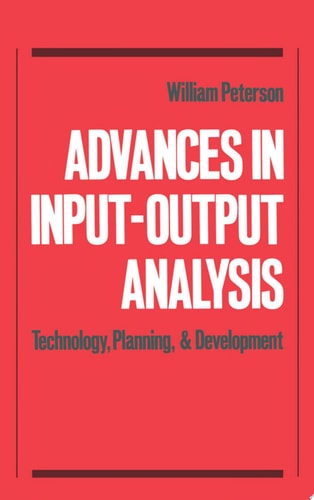
Advances in Input-Output Analysis: Technology, Planning, and Development
0
0
As an Amazon Associate and affiliate partner, Menrva Books earns from qualifying purchases. Learn more
Author Description
Input-output analysis, developed by Nobel Prize winner Wassily Leontief, continues to be a vital area of research. Not only do academics find it a powerful tool in understanding how large scale economies--especially national economies--work, but many governments maintain computer input-output models to study their own economies. This important volume of work contains the latest research using the I-O model, focusing primarily on technology, planning, and development. The book derives from a conference held in Sapporo, Japan, in July, 1986.
Menrva's Summary
THE THESIS
This volume investigates the contemporary applications and theoretical advancements of input-output analysis within the contexts of national planning, technological change, and economic development. William R. Peterson compiles research presented at a 1986 conference in Sapporo, Japan, to demonstrate how the Leontief model remains a functional framework for both academic inquiry and governmental policy-making. The text synthesizes diverse perspectives on how these mathematical models can be adapted to analyze large-scale economic structures and developmental trajectories.
THE SCOPE MAP
What You Will Find
- Methodological refinements of the Leontief input-output model
- Case studies on national economic planning and development strategies
- Analysis of the relationship between technological innovation and industrial output
- Empirical data derived from international economic research presented at the 1986 Sapporo conference
THE AUTHORITY PERSPECTIVE
Experts recognize this volume as a significant record of mid-1980s economic modeling and its practical implementation in government policy. Readers frequently note the technical density of the prose, which is tailored for economists and researchers familiar with quantitative analysis.
Page Count:
256
Publication Date:
1991-11-14
Publisher:
Oxford University Press
ISBN-10:
0195062361
ISBN-13:
9780195062366
Economics
Econometrics
Technology
Input-output Analysis
Planning
Linear Programming
Community Tags
Similar Books