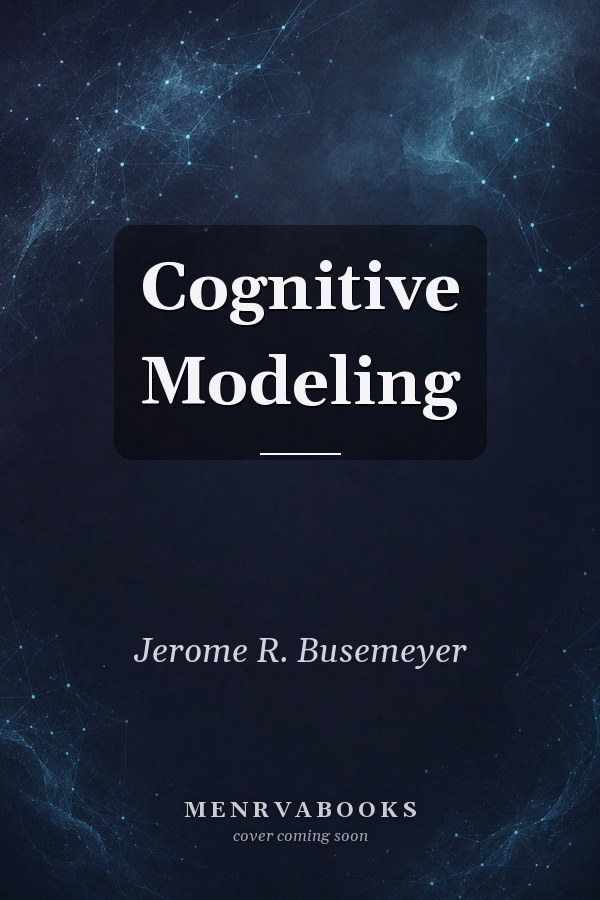
Cognitive Modeling
0
0
As an Amazon Associate and affiliate partner, Menrva Books earns from qualifying purchases. Learn more
Author Description
Cognitive Modeling is the first book to provide students with an easy-to understand introduction to the basic methods used to build and test cognitive models. Authors Jerome R. Busemeyer and Adele Diederich answer many of the questions that researchers face when beginning work on cognitive models, such as the following: What makes a cognitive model different from conceptual or statistical models? How do you develop such a model? How can you derive qualitatively different predictions between two cognitive models? Focusing on a few key representations, the authors introduce a basic problem in each chapter, illustrate the concept with three examples, and end with a summary of general principles, making this book by far the most accessible cognitive modeling book on the market. Key Features Emphasizes modeling by presenting the tools needed to build a cognitive model, rather than simply reviewing existing models of cognition Provides tutorial presentations of psychological, mathematical, statistical, and computational methods used in all areas of cognitive modeling Includes detailed examples applied to real cognitive models published in the literature in a variety of areas, including recognition, categorization, decision making, and learning Stresses the importance of designing the right conditions for evaluating models Addresses the issues of individual differences in cognitive modeling head-on Cognitive Modeling is ideal for students and researchers across the various domains of cognitive sciences, including perception, learning, decision making, and inference. It is intended for use in upper-level undergraduate and graduate courses such as Cognition/Cognitive Modeling, Cognitive Science, Cognitive Psychology, Quantitative Methods, and Mathematical Modeling in Psychology.
Menrva's Summary
THE THESIS
This book introduces fundamental methods for constructing and evaluating cognitive models. It addresses common questions faced by new researchers, such as differentiating cognitive models from conceptual or statistical ones, developing these models, and deriving distinct predictions between them. The authors focus on key representations, presenting a core problem in each chapter, illustrating it with three examples, and concluding with general principles to ensure accessibility.
THE SCOPE MAP
- What makes a cognitive model different from conceptual or statistical models?
- How do you develop a cognitive model?
- How can you derive qualitatively different predictions between two cognitive models?
- Tutorial presentations of psychological, mathematical, statistical, and computational methods.
- Detailed examples applied to real cognitive models in recognition, categorization, decision making, and learning.
- Emphasis on designing appropriate conditions for model evaluation.
- Addressing individual differences in cognitive modeling.
THE AUTHORITY PERSPECTIVE
This text is designed as an accessible introduction to cognitive modeling for students and researchers. Its approach emphasizes practical application by presenting the tools needed to build models, rather than just reviewing existing ones. The inclusion of detailed examples from published literature across various cognitive domains aims to solidify understanding. The book is structured to facilitate learning through problem-based chapters and summaries of general principles, making it suitable for upper-level undergraduate and graduate courses.
Page Count:
0
Publication Date:
2010-01-01
Publisher:
Sage
ISBN-10:
0761924493
ISBN-13:
9780761924494
Psychology
Non-Fiction
Science
Mathematical Modeling
Quantitative Methods
Community Tags
Similar Books