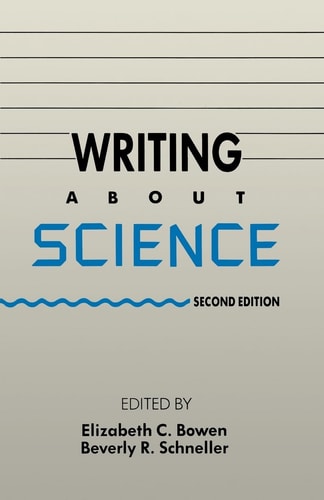
Writing About Science
0
0
As an Amazon Associate and affiliate partner, Menrva Books earns from qualifying purchases. Learn more
Author Description
The first anthology compiled especially for the reader of scientific and technical writing, Writing About Science is now brought up to date to include some of the most powerful new voices of the past decade. Twenty-seven essays by eminent scientists--written for both popular and professional audiences--provide working models of excellence and show that scientific writing can be both imaginative and concise, efficient as well as entertaining. The contributors range from great scientists of the past, such as Michael Faraday and Charles Darwin, to important names of today, including James Watson, Francis Crick, Lynn Margulis, and Stephen J. Gould. Displaying many styles and intended for a variety of audiences, the selections are especially broad in scope: some of the essays were originally written for scientific or technical journals; others are excerpts from best-selling books; still others were first given as lectures. Helpful introductions outline each author's life and contribution to science and place each selection in chronological and thematic context. Especially valuable is a supplementary table of contents that arranges the essays by rhetorical method, underlining the continuity between scientific exposition and writing from the traditional liberal arts. Covering a wide range of scientific writing and fully revised to include nine new essays, Writing About Science remains essential for anyone who needs to communicate scientific material in a compelling and lively fashion.
Menrva's Summary
THE THESIS
This anthology investigates the intersection of technical precision and narrative clarity, posing the question of how scientific communication can remain both rigorous and accessible to diverse audiences. Editors Beverly E. Schneller and Elizabeth C. Bowen curate a collection of twenty-seven essays from prominent scientific figures to demonstrate that effective technical writing relies on imaginative structure and concise prose. By analyzing works from historical figures like Charles Darwin alongside contemporary researchers like Lynn Margulis, the authors provide a framework for understanding how scientific exposition functions across different media and rhetorical contexts.
THE SCOPE MAP
What You Will Find
- A curated selection of twenty-seven essays spanning historical and modern scientific discourse.
- A supplementary table of contents organized by rhetorical method to assist in writing instruction.
- Biographical introductions that contextualize each scientist's contribution and historical significance.
- Diverse source material including technical journals, popular science books, and public lectures.
THE AUTHORITY PERSPECTIVE
Experts and educators frequently cite this collection as a foundational resource for students and professionals seeking to bridge the gap between technical data and public engagement. Readers note the utility of the rhetorical organization, which helps writers apply traditional liberal arts techniques to complex scientific subject matter.
Page Count:
400
Publication Date:
1991-02-14
Publisher:
Oxford University Press
ISBN-10:
0195062744
ISBN-13:
9780195062748
Science
Non-Fiction
Reference
Writing
Essays
Technical Writing
Education
Community Tags
Similar Books