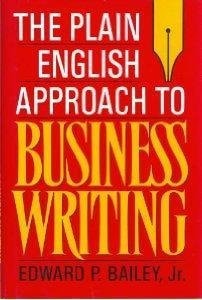
The Plain English Approach to Business Writing
0
0
As an Amazon Associate and affiliate partner, Menrva Books earns from qualifying purchases. Learn more
Author Description
In offices across America, the Masters of Gobbledygook are hard at work. They're bombarding in-boxes with those long, confusing memos that colleagues don't have the patience to read--and bosses don't have the time to rewrite. They use words like "commence" or "prior to" instead of "begin" or "before." They bury their main point somewhere in the last paragraph--and take two pages to get there. Everybody knows one of them; in fact, you may even be one of them. But now there's help for anyone who's ever fallen prey to businessese, academese, legalese, or any other "ese" when faced with a blank memo pad.In The Plain English Approach to Business Writing, Edward Bailey--who spent twenty years working in the bastions of bureaucratese--offers readers a powerful new communications tool. Written for busy professionals who want to improve the quality and clarity of their own (or their staff's) writing style, this no-nonsense guide is an indispensable office companion. Bailey's approach is surprisingly straightforward: just write as you would talk. Plain English is not only easier to read; it's also easier to write. And it's so effective that many large organizations are endorsing, if not demanding, its use in the work place. Pithy and entertaining, Bailey points out all the dos and don'ts of plain English. He then illustrates them with examples drawn from a wide array of sources, including business documents, technical manuals, trade publications like Consumer Reports, and the works of writers such as Russell Baker and John D. MacDonald. From the basics to the fine tuning, he offers practical advice on clarity and precision, organization, layout, and a host of other important writing topics.A delightful, down-to-earth guide, The Plain English Approach to Business Writing is for professionals of all backgrounds (government, military, legal, financial, technical, corporate) and staff at all levels (from the company CEO to the ambitious secretary).
Menrva's Summary
THE THESIS
Can professional communication be improved by replacing bureaucratic jargon with direct, conversational language? Edward P. Bailey Jr., drawing on two decades of experience navigating corporate and government bureaucracies, argues that clarity is the primary objective of effective business writing. He posits that the most efficient way to communicate is to adopt a conversational tone, stripping away the unnecessary complexity often found in corporate memos and reports.
THE SCOPE MAP
What You Will Find
- Practical techniques for eliminating jargon and wordy phrasing in professional documents.
- Strategies for organizing information to ensure the main point is presented early.
- Comparative analysis of effective versus ineffective writing samples from diverse industries.
- Guidelines for improving document layout and overall readability for busy readers.
THE AUTHORITY PERSPECTIVE
Professionals frequently cite this text as a highly accessible and practical resource for improving workplace communication. Experts highlight the book's ability to simplify complex writing concepts into actionable advice for employees at all levels of an organization.
Page Count:
128
Publication Date:
1990-09-13
Publisher:
Oxford University Press
ISBN-10:
0195064909
ISBN-13:
9780195064902
Business
Professional Development
Writing
Communication
Reference
Community Tags
Similar Books