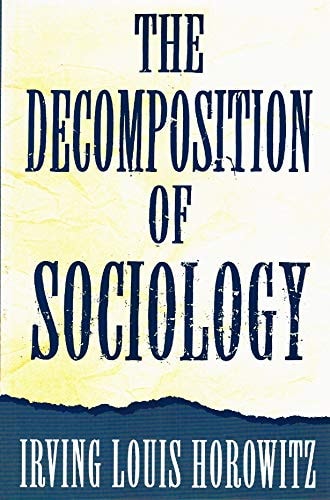
The Decomposition of Sociology
0
0
As an Amazon Associate and affiliate partner, Menrva Books earns from qualifying purchases. Learn more
Author Description
Sociology, writes Irving Louis Horowitz, has changed from a central discipline of the social sciences to an ideological outpost of political extremism. As a result, the field is in crisis. Some departments have been shut down, others cut back, research programs have dried up, and the growth of professional organizations and student enrollments have been either curbed or atrophied. In The Decomposition of Sociology, Professor Horowitz, for four decades a leading social scientist, offers a frank and full account of the maelstrom engulfing this field.Horowitz pulls no punches in this provocative volume. He charges that much contemporary sociological theory has degenerated into pure critique, strongly influenced by Marxist dogmatism. Such thinking has a strong element of anti-American and anti-Western bias, in which all questions have one answer--the evil of capitalism--and all problems one solution--the good of socialism. In criminology, for instance, he shows that high crime rates are seen as an expression of capitalist disintegration, and criminal behavior a covert expression of radical action. Indeed, in one area after another, Horowitz shows how this same formulaic thinking dominates the field, resulting in a crude reductionist view of contemporary social life. At a time when the world is moving closer to the free market and democratic norms, he concludes, such reductionist tendencies and ideological posturings are outmoded.Horowitz offers an alternative. He urges a larger vision of the social sciences, one in which universities, granting agencies and research institutes provide an environment in which research may be untainted by partisan agencies--where policy choices will not be hindered by the prevailing cultural climate. He counsels sociologists to move away from blind advocacy, to meet the challenges of the twenty-first century by incorporating the knowledge of other times and places, and to take into account the shrinking globe--in short, to develop and main
Menrva's Summary
THE THESIS
Irving Louis Horowitz investigates the decline of sociology as a rigorous academic discipline, arguing that it has been compromised by ideological extremism and political bias. Drawing on his four-decade career as a prominent social scientist, Horowitz examines the institutional and intellectual decay within the field. He posits that the shift toward Marxist-influenced critique has replaced empirical research with formulaic, reductionist thinking, ultimately alienating the discipline from the realities of a globalized, democratic world.
THE SCOPE MAP
What You Will Find
- Analysis of the institutional decline of sociology departments and professional organizations.
- Critique of the influence of Marxist dogmatism on contemporary sociological theory.
- Examination of how ideological bias distorts research in specialized areas like criminology.
- Proposals for restoring academic integrity through non-partisan research environments and global perspectives.
THE AUTHORITY PERSPECTIVE
Critics and scholars often cite this work as a significant, albeit polarizing, critique of the state of modern social science. Readers frequently note the provocative nature of Horowitz's arguments, which continue to serve as a reference point for debates regarding the politicization of academic research.
Page Count:
288
Publication Date:
1993-10-14
Publisher:
Oxford University Press
ISBN-10:
0195073169
ISBN-13:
9780195073164
Sociology - History
Sociology
Social Science
Education
Community Tags
Similar Books