Energy Conversion: Systems, Flow Physics and Engineering
0
0
As an Amazon Associate and affiliate partner, Menrva Books earns from qualifying purchases. Learn more
Author Description
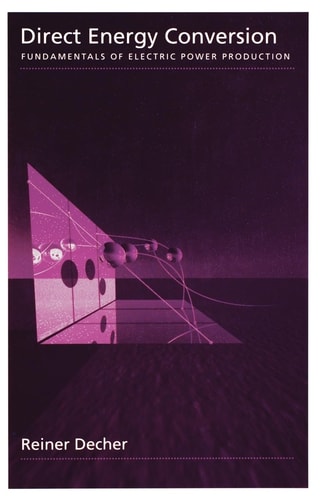
As conventional energy sources such as fossil fuels become increasingly scarce, scientists and engineers will need to rely more and more on new sources such as geothermal, solar, ocean thermal, magnetohydrodynamic, nuclear, and hydrogen energy to meet the world's energy demands. The utilization of all these forms of energy involves the conversion of heat to mechanical energy.Designed for senior level undergraduates, Energy Conversion develops an understanding of the physical processes involved in the transformation of one form of energy to another. The emphasis is on a description of models of the elementary processes to allow assessment of performance potential and to allow a determination of the sensitivity to design choices. Since many energy conversion processes involve the manipulation of gaseous substances, there is heavy emphasis on the description of fluids and gases in particular. Energy conversion processes involve heat and work interactions between a system and its environment, as well as state and property decisions.In order to arrive at simple, understandable relations, simplifications are made which allow description at the expense of some numerical accuracy. More accurate descriptions can be made with more sophisticated computational tools and nearly all numerical calculations presented are made with the equations developed, so that the student can implement them on a computer and reproduce them with his or her own choice of parameters. In most chapters, problems are presented which are designed to aid the student in the practical applications of the underlying principles of energy conversion to the performance of real engines.Energy Conversion offers extensive coverage of basic principles, applied thermodynamics, the economics of power plants, turbomachinery, and lucid discussion of the environmental impact of energy conversion.
Menrva's Summary
THE THESIS
This text investigates the fundamental physical processes and engineering principles required to convert various energy sources into mechanical work. Reiner Decher, an expert in engineering science, provides a rigorous framework for assessing the performance potential of diverse energy systems. By focusing on the manipulation of fluids and gases, the book establishes a mathematical foundation that allows students to evaluate design sensitivities and system efficiencies. The author emphasizes the development of simplified models that facilitate a clear understanding of complex thermodynamic interactions.
THE SCOPE MAP
What You Will Find
- Comprehensive analysis of energy conversion from geothermal, solar, nuclear, and hydrogen sources.
- Mathematical models for fluid and gas dynamics in power systems.
- Practical problem sets designed for computational implementation and parameter testing.
- Discussion on the economics of power plants and the environmental impact of energy conversion technologies.
THE AUTHORITY PERSPECTIVE
Experts and educators frequently cite this work as a foundational text for senior-level undergraduate engineering curricula. Readers often note the technical density of the prose, which requires a solid background in thermodynamics to fully grasp the presented models.
Page Count:
704
Publication Date:
1994-12-29
Publisher:
Oxford University Press
ISBN-10:
0195079590
ISBN-13:
9780195079593
Thermodynamics
Technology
Engineering
Energy
Physics
Community Tags
Similar Books