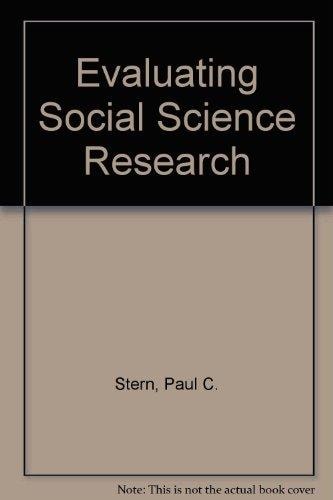
Evaluating Social Science Research
0
0
As an Amazon Associate and affiliate partner, Menrva Books earns from qualifying purchases. Learn more
Author Description
This critically acclaimed book serves a timely purpose by addressing the ever-important need to develop critical thinking skills. Major advances in the social sciences in recent years have been incorporated in an explicit discussion of quasi-experimental research design, including an added distinction between equivalent- and nonequivalent-group experiments, and revised explanations of the logic of multiple regression analysis, causal modeling, and meta-analysis, all new to this edition. The authors retain their firm philosophical grounding in the positivist tradition, arguing around the central concepts of "statement of fact" and "scientific evidence."
Menrva's Summary
THE THESIS
This book investigates the fundamental question of how to cultivate critical thinking skills necessary for evaluating social science research effectively. Authors Linda Kalof and Paul C. Stern utilize their expertise to provide a rigorous framework for understanding scientific evidence. By grounding their analysis in the positivist tradition, they examine the logical structures required to interpret complex data and research findings in contemporary social science.
THE SCOPE MAP
What You Will Find
- Detailed explanations of quasi-experimental research design
- Comparative analysis of equivalent and nonequivalent group experiments
- Methodological overviews of multiple regression analysis and causal modeling
- Technical guidance on the application of meta-analysis in social research
THE AUTHORITY PERSPECTIVE
Experts and educators frequently identify this text as a foundational resource for students learning to navigate the complexities of social science methodology. Readers often note the academic density of the prose, which serves to clarify advanced statistical and logical concepts for those entering the field.
Page Count:
279
Publication Date:
1996-04-04
Publisher:
Oxford University Press
ISBN-10:
0195079698
ISBN-13:
9780195079692
Social Science
Critical thinking
Statistics
Education
Social Research
Research Methods
Community Tags
Similar Books