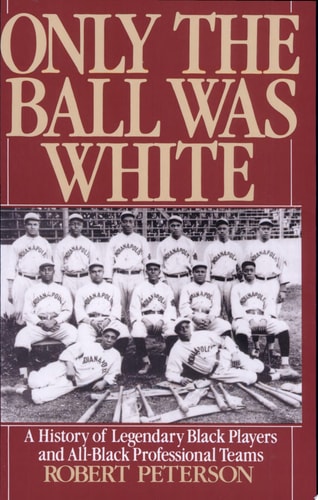
Only the Ball Was White: A History of Legendary Black Players and All-Black Professional Teams
0
0
As an Amazon Associate and affiliate partner, Menrva Books earns from qualifying purchases. Learn more
Author Description
Early in the 1920s, the New York Giants sent a scout to watch a young Cuban play for Foster's American Giants, a baseball club in the Negro Leagues. During one at-bat this talented slugger lined a ball so hard that the rightfielder was able to play it off the top of the fence and throw Christobel Torrienti out at first base. The scout liked what he saw, but was disappointed in the player's appearance. "He was a light brown," recalled one of Torrienti's teammates, "and would have gone up to the major leagues, but he had real rough hair." Such was life behind the color line, the unofficial boundary that prevented hundreds of star-quality athletes from playing big-league baseball.When Only the Ball Was White was first published in 1970, Satchel Paige had not yet been inducted into the Hall of Fame and there was a general ignorance even among sports enthusiasts of the rich tradition of the Negro Leagues. Few knew that during the 1930s and '40s outstanding black teams were playing regularly in Yankee Stadium and Brooklyn's Ebbets Field. And names like Cool Papa Bell, Rube Foster, Judy Johnson, Biz Mackey, and Buck Leonard would bring no flash of smiling recognition to the fan's face, even though many of these men could easily have played alongside Ty Cobb, Walter Johnson, Hack Wilson, Lou Gehrig--and shattered their records in the process. Many baseball pundits now believe, for example, that had Josh Gibson played in the major leagues, he would have surpassed Babe Ruth's 714 home runs before Hank Aaron had even hit his first. And the great Dizzy Dean acknowledged that the best pitcher he had ever seen was not Lefty Grove or Carl Hubbell, but rather "old Satchel Paige, that big lanky colored boy."In Only the Ball Was White, Robert Peterson tells the forgotten story of these excluded ballplayers, and gives them the recognition they were so long denied. Reconstructing the old Negro Leagues from contemporary sports publications, accounts of games in the black press, and thro
Menrva's Summary
THE THESIS
This work investigates the historical exclusion of Black athletes from professional baseball and documents the vibrant, often overlooked legacy of the Negro Leagues. Robert M. Peterson, a veteran sports journalist, utilizes a rigorous research methodology to reconstruct the history of these teams. By synthesizing accounts from the Black press, contemporary sports publications, and personal interviews, he challenges the historical narrative that ignored the talent and contributions of Black players during the era of segregation.
THE SCOPE MAP
What You Will Find
- Detailed history of the Negro Leagues from the early 20th century through the integration of Major League Baseball.
- Profiles of legendary figures including Satchel Paige, Josh Gibson, Rube Foster, and Cool Papa Bell.
- Analysis of the systemic barriers and the unofficial color line that prevented Black athletes from competing in the major leagues.
- Documentation of the high level of play and competitive success of all-Black professional teams in major stadiums.
THE AUTHORITY PERSPECTIVE
Experts and sports historians regard this book as a foundational text that brought the history of the Negro Leagues into the mainstream consciousness. Readers frequently note the meticulous archival research and the author's ability to preserve the oral histories of players who were otherwise omitted from official record books.
Page Count:
416
Publication Date:
1992-04-30
Publisher:
Oxford University Press
ISBN-10:
0195076370
ISBN-13:
9780195076370
Biography
History
Sports
Baseball - History
Baseball
Negro Leagues
Community Tags
Similar Books

Reader Comments
Share Your Thoughts
No comments yet. Be the first to share your thoughts!