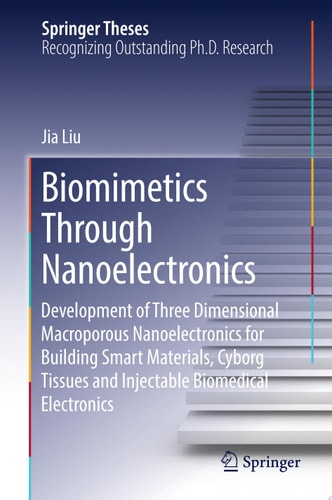
Biomimetics Through Nanoelectronics
0
0
As an Amazon Associate and affiliate partner, Menrva Books earns from qualifying purchases. Learn more
Author Description
This thesis presents original research on how to seamlessly integrate electronics with living biological systems. Jia Liu has used silicon nanowires as active sensors to investigate biological signals at the cellular level. He has also designed nanoelectronic networks into flexible, three-dimensional (3D) and macroporous architectures, which mimic the structure of tissue scaffolds for in vitro 3D integrations with synthetic tissues and in vivo implantation by means of syringe injection. Importantly, the results demonstrate 3D interpenetrations of nanoelectronic networks with neural networks, 3D mapping of tissue activity and long-term implantation with minimal immunoresponses. Further, the book discusses potential applications for pharmacological studies, brain activity mapping and nanoelectronics enabled therapies. The findings presented here have gained wide recognition, including a top research ranking by Chemical & Engineering News and being listed among Scientific American’s 10 world changing ideas in 2015.
Menrva's Summary
THE THESIS
This thesis investigates the integration of nanoelectronics with living biological systems to create advanced biosensors and implantable devices. Jia Liu's research focuses on utilizing silicon nanowires as active sensors for detecting biological signals at the cellular level. The work details the design of nanoelectronic networks into flexible, 3D, and macroporous architectures that mimic tissue scaffolds, enabling in vitro integration with synthetic tissues and in vivo implantation via syringe injection. The findings demonstrate successful 3D interpenetrations with neural networks, mapping of tissue activity, and long-term implantation with minimal immune response, opening avenues for novel therapeutic and diagnostic applications.
THE SCOPE MAP
- Integration of silicon nanowires as active biosensors.
- Design of flexible, 3D, and macroporous nanoelectronic networks.
- Mimicry of tissue scaffold structures for biological integration.
- In vitro and in vivo implantation methodologies.
- Demonstrations of 3D interpenetration with neural networks.
- Mapping of tissue activity and analysis of immunoresponses.
- Discussion of potential applications in pharmacology, brain mapping, and nanoelectronics-enabled therapies.
THE AUTHORITY PERSPECTIVE
The findings presented in this thesis have garnered significant recognition, including a top research ranking by Chemical & Engineering News and inclusion in Scientific American’s 10 world changing ideas in 2015. This indicates a strong reception within the scientific community, highlighting the novelty and potential impact of the research. The work is acknowledged for its advancements in seamlessly integrating electronics with biological systems, particularly through the innovative use of nanoelectronic architectures.
Page Count:
98
Publication Date:
2017-11-16
Publisher:
Springer Nature
ISBN-10:
3319686097
ISBN-13:
9783319686097
Science & Technology
Science
Non-Fiction
Engineering
Biotechnology
Nanotechnology
Community Tags
Similar Books