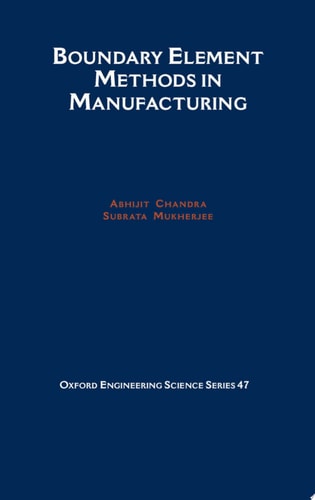
Boundary Element Methods in Manufacturing
0
0
As an Amazon Associate and affiliate partner, Menrva Books earns from qualifying purchases. Learn more
Author Description
This book focuses on the analysis of manufacturing processes and the integration of this analysis into the design cycle. Uniquely, the boundary element method (BEM) is the computational model of choice. This versatile and powerful method has undergone extensive development during the past two decades and has been applied to virtually all areas of engineering mechanics as well as to other fields. Among topics covered are BEM infrastructure, design sensitivity analysis, and detailed discussions of a broad range of manufacturing processes including forming, solidification, machining, and ceramic grinding.
Menrva's Summary
THE THESIS
This text investigates the application of the boundary element method (BEM) as a primary computational framework for analyzing and optimizing complex manufacturing processes. Authors Abhijit Chandra and Subrata Mukherjee leverage their expertise in engineering mechanics to bridge the gap between theoretical computational modeling and practical design cycles. The book presents a systematic argument for the versatility of BEM, demonstrating its utility in simulating diverse industrial operations ranging from material solidification to precision machining.
THE SCOPE MAP
What You Will Find
- Comprehensive infrastructure and mathematical foundations of the boundary element method
- Design sensitivity analysis techniques for manufacturing optimization
- Detailed case studies on forming, solidification, machining, and ceramic grinding processes
- Integration strategies for computational models within the industrial design cycle
THE AUTHORITY PERSPECTIVE
Experts recognize this volume as a specialized technical reference for engineers and researchers working in computational manufacturing. Readers frequently note the academic density of the prose, which assumes a strong background in engineering mechanics and numerical analysis.
Page Count:
528
Publication Date:
1997-04-10
Publisher:
Oxford University Press
ISBN-10:
0195079213
ISBN-13:
9780195079210
Computational Mechanics
Engineering
Technology
Manufacturing
Manufacturing processes
Applied Mathematics
Community Tags
Similar Books