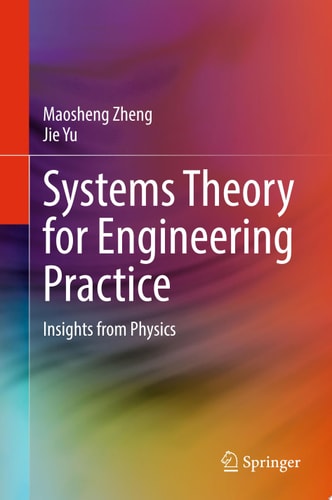
Systems Theory for Engineering Practice
0
0
As an Amazon Associate and affiliate partner, Menrva Books earns from qualifying purchases. Learn more
Author Description
This book presents cognition of the universality of systems theory thinking by using some ordinary physical phenomena and their methods in study, of which the involved treatments are consistent with the viewpoint of systems theory. It contains the collective actions of classical vibration of many bodies and wave, the extreme value problem in natural world, status of electrons in atom-molecule and metals, Ising model in phase transition and elementary excitation in solid, multi-objective optimization in a system, description of effective media approximation, certainty in uncertain phenomena, all these reflect the cooperative/synergetic effects, wholeness of group actions, “unity of opposites” inside a system, and collective phenomena in a system completely. The relevant methodologies for systems theory are organic combination and synergism of both “reductionism” and “holism” instead of “confrontation” or “separation” of them, which could be used in dealing with analogous problems in systems science and engineering fields in response to the idiom of “stones from other hills being good for polishing this jade” and “comprehend by analogy”, so as to promote the transformation of wisdom to productivity. The authors wish this work could play its role as a paving stone to serve the research and application of systems theory. This book can be used as a textbook for postgraduate and advanced undergraduate students in relevant majors, and a reference book for scientists and practitioners in related fields.
Menrva's Summary
THE THESIS
This book investigates the universality of systems theory thinking by applying its principles to ordinary physical phenomena and engineering problems. The authors, Jie Yu and Maosheng Zheng, draw upon their expertise to demonstrate how systems theory can be integrated with traditional scientific methodologies like reductionism and holism. The text explores concepts such as collective actions in classical vibration and waves, electron behavior in atoms and molecules, phase transitions in the Ising model, and multi-objective optimization, all reflecting cooperative effects and the wholeness of group actions within systems. It aims to promote the transformation of wisdom into productivity by offering a framework for dealing with analogous problems in systems science and engineering.
THE SCOPE MAP
- Analysis of collective actions in classical vibration of many bodies and wave phenomena.
- Examination of extreme value problems in natural phenomena.
- Description of electron status in atom-molecule and metals.
- Discussion of the Ising model in phase transition and elementary excitation in solids.
- Exploration of multi-objective optimization within systems.
- Application of effective media approximation.
- Treatment of certainty in uncertain phenomena, highlighting cooperative/synergetic effects and the "unity of opposites".
THE AUTHORITY PERSPECTIVE
The book is intended as a textbook for postgraduate and advanced undergraduate students in relevant majors, and as a reference for scientists and practitioners. Its approach emphasizes the organic combination and synergism of reductionism and holism, rather than their confrontation, to address complex problems. The authors aim for the work to serve as a foundational text for the research and application of systems theory.
Page Count:
156
Publication Date:
2024-12-02
Publisher:
Springer Nature
ISBN-10:
9819793424
ISBN-13:
9789819793426
Non-Fiction
Science
Systems Theory
Optimization
Community Tags
Similar Books