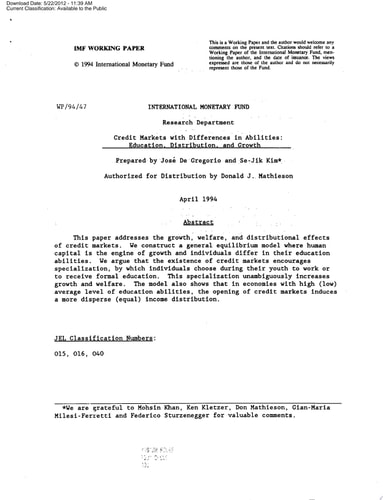
Credit Markets with Differences in Abilities Education, Distribution, and Growth
0
0
As an Amazon Associate and affiliate partner, Menrva Books earns from qualifying purchases. Learn more
Author Description
This paper addresses the growth, welfare, and distributional effects of credit markets. We construct a general equilibrium model where human capital is the engine of growth and individuals differ in their education abilities. We argue that the existence of credit markets encourages specialization, by which individuals choose during their youth to work or to receive formal education. This specialization unambiguously increases growth and welfare. The model also shows that in economies with high (low) average level of education abilities, the opening of credit markets induces a more disperse (equal) income distribution.
Menrva's Summary
THE THESIS
This paper investigates the multifaceted impacts of credit markets on economic growth, welfare, and income distribution, particularly when individuals possess varying educational aptitudes. The authors develop a general equilibrium model where human capital accumulation drives economic expansion, and agents are distinguished by their innate abilities in education. The core argument posits that the introduction of credit markets facilitates specialization, enabling individuals to decide in their youth whether to pursue formal education or enter the workforce, which in turn demonstrably enhances both economic growth and overall welfare. Furthermore, the model reveals a nuanced relationship between credit markets and income distribution, showing that in societies with high average educational abilities, credit markets lead to a wider income dispersion, while in those with low average abilities, they promote greater income equality.
THE SCOPE MAP
- A general equilibrium model framework for analyzing credit markets.
- Analysis of human capital as the primary driver of economic growth.
- Examination of individual differences in education abilities.
- The role of credit markets in fostering specialization between work and education.
- The impact of credit markets on economic growth and welfare.
- The relationship between credit markets and income distribution, considering average educational abilities.
THE AUTHORITY PERSPECTIVE
This academic paper presents a theoretical model exploring the economic consequences of credit markets in an economy with heterogeneous individuals. The analysis focuses on how these markets influence growth, welfare, and the distribution of income based on varying educational abilities and choices. The authors' framework suggests that credit markets are instrumental in promoting specialization, leading to positive outcomes for both economic expansion and societal well-being. The paper also offers insights into how the presence of credit markets can alter income inequality depending on the general educational capacity of the population.
Page Count:
36
Publication Date:
1994-04-01
Publisher:
International Monetary Fund
ISBN-10:
1451972962
ISBN-13:
9781451972962
Economics
Non-Fiction
Finance
Education
Community Tags
Similar Books