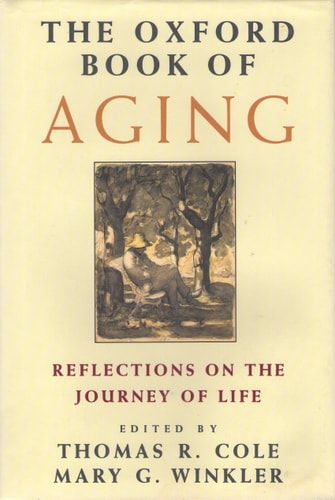
The Oxford Book of Aging
0
0
As an Amazon Associate and affiliate partner, Menrva Books earns from qualifying purchases. Learn more
Author Description
Most of us today can expect to live into our seventies in reasonably good health. (In fact, the fastest growing segment of the population is the group eighty-five and older.) Yet our culture offers few convincing ways to help us find purpose in our later years. The ancient and medieval vision of aging as a mysterious part of the eternal order of things has given way to the secular, scientific, and individualistic outlook of modernity. No longer seen as a way station along life's spiritual journey, old age has been redefined as a problem to be solved by science and medicine. Older people have been moved to society's margins, and, as a result, we have become uncertain about what it means to age.To help us make sense of our journey through life, The Oxford Book of Aging offers some two hundred and fifty pieces that illuminate the pleasures, pains, dreams, and triumphs of people as they strive to live out their days in a meaningful way. Fiction, poetry, memoirs, essays, children's stories, reflections by philosophers, historians, and psychologists, African and Japanese legends, excerpts from the Koran and the Bible, scientific and medical tracts--the variety of writings is remarkable. The excerpts shed light on the many aspects of later life, including creativity, love, memory, spiritual growth, and the value of work. The perspectives range from Schopenhauer's dark "Disillusion is the chief characteristic of old age" when we come "by degrees to see that our existence is all empty and void," to Robert Browning's uplifting "Grow old along with me! / The best is yet to be" (a vision so idealistic that Ogden Nash was moved to write "Such a statement, certes, / Could emanate only from a youngster is his thirties"). We read Mozart's letter to his dying father, Alice Walker's endearing "To Hell With Dying" (about the vital ties between children and the old), Annie Dillard's meditation on her mother's hands, and Mark Twain's tongue-in-cheek formula for reaching age seventy.
Menrva's Summary
THE THESIS
This anthology investigates the cultural and existential crisis of aging in modern society, questioning how individuals can find meaning in later life when traditional spiritual frameworks have been replaced by a purely medicalized view of old age. Editors Mary C. Winkler and Thomas R. Cole curate a vast collection of interdisciplinary texts to challenge the contemporary marginalization of the elderly. By synthesizing historical, literary, and scientific perspectives, the authors argue that aging remains a complex human experience that requires a broader, more integrated understanding than modern science alone provides.
THE SCOPE MAP
What You Will Find
- A diverse collection of over two hundred and fifty excerpts including poetry, memoirs, essays, and religious texts.
- Cross-cultural perspectives on aging, featuring African and Japanese legends alongside Western philosophical thought.
- Scientific and medical tracts contrasted with personal reflections from figures like Mozart and Mark Twain.
- Thematic explorations of creativity, memory, spiritual growth, and the social value of work in later life.
THE AUTHORITY PERSPECTIVE
Experts and readers frequently cite this collection as a foundational resource for understanding the humanistic dimensions of gerontology. The text is noted for its breadth, providing a comprehensive look at how different cultures and eras have conceptualized the final stages of life.
Page Count:
432
Publication Date:
1994-11-03
Publisher:
Oxford University Press
ISBN-10:
019507369X
ISBN-13:
9780195073690
Non-Fiction
Psychology
Philosophy
Sociology
Gerontology
Anthology
Community Tags
Similar Books