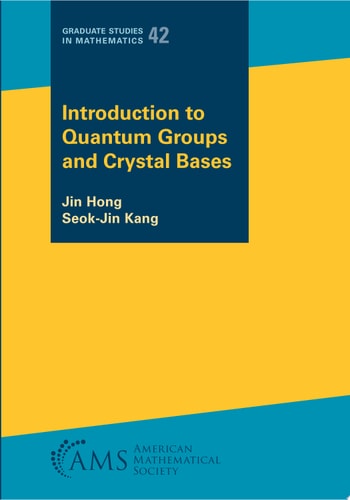
Introduction to Quantum Groups and Crystal Bases
0
0
As an Amazon Associate and affiliate partner, Menrva Books earns from qualifying purchases. Learn more
Author Description
The notion of a “quantum group” was introduced by V.G. Drinfel'd and M. Jimbo, independently, in their study of the quantum Yang-Baxter equation arising from 2-dimensional solvable lattice models. Quantum groups are certain families of Hopf algebras that are deformations of universal enveloping algebras of Kac-Moody algebras. And over the past 20 years, they have turned out to be the fundamental algebraic structure behind many branches of mathematics and mathematical physics, such as solvable lattice models in statistical mechanics, topological invariant theory of links and knots, representation theory of Kac-Moody algebras, representation theory of algebraic structures, topological quantum field theory, geometric representation theory, and $C^*$-algebras. In particular, the theory of “crystal bases” or “canonical bases” developed independently by M. Kashiwara and G. Lusztig provides a powerful combinatorial and geometric tool to study the representations of quantum groups. The purpose of this book is to provide an elementary introduction to the theory of quantum groups and crystal bases, focusing on the combinatorial aspects of the theory.
Menrva's Summary
THE THESIS
This book introduces the fundamental algebraic structures of quantum groups and crystal bases, focusing on their combinatorial aspects. The authors, Jin Ho Hong and Seok-Jin Kang, provide an elementary introduction to these theories, which have become central to numerous areas of mathematics and mathematical physics. Quantum groups, deformations of universal enveloping algebras of Kac-Moody algebras, arose from the study of the quantum Yang-Baxter equation. Crystal bases, developed by Kashiwara and Lusztig, offer a powerful tool for understanding representations of these quantum groups, making this text essential for researchers and graduate students in related fields.
THE SCOPE MAP
- An introduction to the theory of quantum groups as deformations of universal enveloping algebras.
- Detailed explanation of crystal bases (canonical bases) as combinatorial tools for representation theory.
- Focus on the combinatorial aspects of quantum group theory.
- Coverage of applications in areas such as solvable lattice models, knot theory, and representation theory of Kac-Moody algebras.
THE AUTHORITY PERSPECTIVE
The subject matter indicates a text aimed at advanced students and researchers in mathematics and theoretical physics, likely requiring a solid background in algebra. The focus on combinatorial aspects suggests an approach that emphasizes structure and counting over abstract algebraic manipulation. The book's purpose as an elementary introduction implies it will build foundational knowledge for those entering the field, providing a stepping stone to more advanced topics in quantum groups and their representations.
Page Count:
307
Publication Date:
2025-02-06
Publisher:
American Mathematical Society
ISBN-10:
1470479753
ISBN-13:
9781470479756
Science
Non-Fiction
Mathematics
Combinatorics
Algebra
Representation Theory
Community Tags
Similar Books