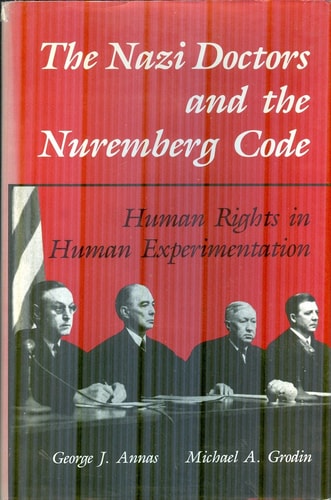
The Nazi Doctors and the Nuremberg Code: Human Rights in Human Experimentation
0
0
As an Amazon Associate and affiliate partner, Menrva Books earns from qualifying purchases. Learn more
Author Description
The atrocities committed by Nazi physicians and researchers during World War II prompted the development of the Nuremberg Code to define the ethics of modern medical experimentation utilizing human subjects. Since its enunciation, the Code has been viewed as one of the cornerstones of modern bioethical thought. The sources and ramifications of this important document are thoroughly discussed in this book by a distinguished roster of contemporary professionals from the fields of history, philosophy, medicine, and law. Contributors also include the chief prosecutor of the Nuremberg Military Tribunal and a moving account by a survivor of the Mengele Twin Experiments. The book sheds light on keenly debated issues of both science and jurisprudence, including the ethics of human experimentation; the doctrine of informed consent; and the Code's impact on today's international human rights agenda. The historical setting of the Code's creation, some modern parallels, and the current attitude of German physicians toward the crimes of the Nazi era, are discussed in early chapters. The book progresses to a powerful account of the Doctors' Trial at Nuremberg, its resulting verdict, and the Code's development. The Code's contemporary influence on both American and international law is examined in its historical context and discussed in terms of its universality: are the foundational ethics of the Code as valid today as when it was originally penned? The editors conclude with a chapter on foreseeable future developments and a proposal for an international covenant on human experimentation enforced by an international court. A major work in medical law and ethics, this volume provides stimulating, provocative reading for physicians, legal professionals, bioethicists, historians, biomedical researchers, and concerned laypersons.
Menrva's Summary
THE THESIS
This volume investigates the historical origins and enduring legal significance of the Nuremberg Code as the foundational framework for modern medical ethics and human rights in experimentation. Editors George J. Annas and Michael A. Grodin assemble a multidisciplinary team of historians, philosophers, legal scholars, and medical professionals to analyze the Doctors' Trial at Nuremberg. The text evaluates whether the ethical principles established in the wake of Nazi atrocities remain universally applicable to contemporary biomedical research and international jurisprudence.
THE SCOPE MAP
What You Will Find
- Historical analysis of the Nazi Doctors' Trial and the subsequent development of the Nuremberg Code.
- Legal examination of the doctrine of informed consent and its evolution in international law.
- Primary source accounts, including testimony from survivors of the Mengele Twin Experiments.
- Proposals for an international covenant on human experimentation and enforcement mechanisms.
THE AUTHORITY PERSPECTIVE
Experts identify this volume as a foundational text for understanding the intersection of medical practice and human rights law. Readers frequently note the academic density of the prose, which serves as a comprehensive resource for bioethicists, legal professionals, and historians.
Page Count:
400
Publication Date:
1992-05-07
Publisher:
Oxford University Press
ISBN-10:
0195070429
ISBN-13:
9780195070422
History
Bioethics
Human rights
Law
Medical Ethics
Medicine history
Community Tags
Similar Books