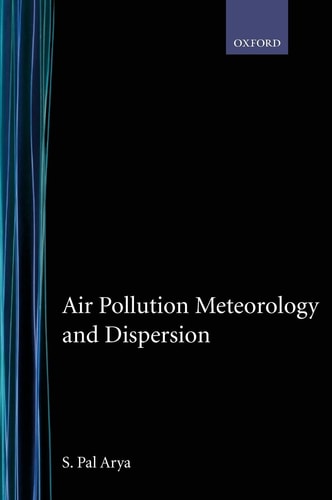
Air Pollution Meteorology and Dispersion
0
0
As an Amazon Associate and affiliate partner, Menrva Books earns from qualifying purchases. Learn more
Author Description
Air Pollution Meteorology and Dispersion provides a concise yet thorough review of the basic theories, models, experiments, and observations of pollutant dispersal in the atmosphere. It offers the theoretical and empirical bases of frequently used dispersion models while emphasizing the limitations and uncertainties inherent in these models. Organized into twelve chapters, the material is presented in order of increasing difficulty. The first half of the book treats the basic tenets of air pollution modeling; the second half deals with the more detailed theoretical and observational aspects of dispersion. Sufficient background material on atmospheric structure, dynamics, and circulation systems and their importance to atmospheric dispersion is included for students who do not yet have a strong meteorological background. Turbulence and diffusion theories, such as gradient transport, statistical, and similarity theories, as well as analytical and numerical dispersion and air quality models, are also discussed. Problems and exercises are included in each chapter, making this an ideal text for undergraduate and graduate courses in atmospheric science and mechanical engineering.
Menrva's Summary
THE THESIS
This text investigates the fundamental physical principles and mathematical frameworks governing the transport and dispersion of pollutants within the Earth's atmosphere. S. Pal Arya, a recognized expert in atmospheric boundary layer research, synthesizes decades of meteorological data and fluid dynamics to provide a structured approach to air quality modeling. The book establishes a rigorous theoretical foundation while simultaneously addressing the practical limitations and inherent uncertainties found in current predictive dispersion models.
THE SCOPE MAP
What You Will Find
- Comprehensive coverage of atmospheric structure, dynamics, and circulation systems.
- Detailed analysis of turbulence and diffusion theories, including gradient transport and similarity theories.
- Evaluation of analytical and numerical air quality models used in environmental engineering.
- Pedagogical tools including chapter-specific problems and exercises for academic application.
THE AUTHORITY PERSPECTIVE
Experts and educators frequently cite this work as a foundational text for students in atmospheric science and mechanical engineering. Readers often note the academic density of the prose, which effectively balances complex theoretical derivations with practical application in environmental modeling.
Page Count:
320
Publication Date:
1998-09-03
Publisher:
Oxford University Press
ISBN-10:
0195073983
ISBN-13:
9780195073980
Science
Atmospheric Science
Engineering
Air
Meteorology
Community Tags
Similar Books