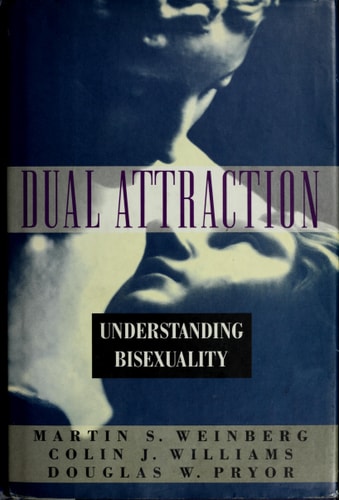
Dual Attraction: Understanding Bisexuality
0
0
As an Amazon Associate and affiliate partner, Menrva Books earns from qualifying purchases. Learn more
Author Description
For the past two generations, extensive research has been conducted on the determinants of homosexuality. But, until now, scant attention has been paid to what is perhaps the most mysterious--and potentially illuminating--variation of human sexual expression, bisexuality. Today, as ignorance and fear of AIDS makes greater awareness of all forms of sexual behavior an urgent matter of private and public consequence, leading sex researchers Martin Weinberg, Colin Williams, and Douglas Pryor provide us with the first major study of bisexuality.Weinberg, Williams, and Pryor explore the riddle of dual attraction in their study of 800 residents of San Francisco. Fieldwork, intensive interviews, and surveys provided a wealth of data about the nature of bisexual attraction, the steps that lead people to become bisexual, and how sexual preference can change over time. They found that heterosexuals, more often than homosexuals, become bisexual; that bisexual men and women differ markedly in their sexual behavior and romantic feelings; that most bisexuals ultimately settle into long-term relationships while continuing sexual activity outside those relationships; and they also explain why transsexuals often become bisexual. Moreover, the authors discovered that as the AIDS crisis unfolded, many bisexual men entered into monogamous relationships with women, and bisexual women into more lesbian relationships.Recent media accounts attest that a growing number of researchers and writers are narrowing the fundamental cause of sexual preference to a single factor, biology. But if, as this study shows, learning plays a significant part in helping people traverse the boundaries of gender, if past and present intimate relationships influence their changing preferences, and if bisexual activity is inseparable from a social environment which provides distinctive sexual opportunities, then a mosaic of factors far more complex than those previously considered must be entertained in explainin
Menrva's Summary
THE THESIS
This study investigates the complex determinants of bisexuality, challenging the reductionist view that sexual preference is solely a product of biological factors. The authors, a team of prominent sex researchers, utilize extensive fieldwork and empirical data gathered from 800 residents in San Francisco to construct a multifaceted framework for understanding sexual orientation. By analyzing the interplay between social environments, personal history, and intimate relationships, they argue that bisexuality is a dynamic expression of human behavior rather than a static identity.
THE SCOPE MAP
What You Will Find
- Empirical data derived from 800 intensive interviews and surveys conducted in San Francisco.
- Comparative analysis of sexual behavior and romantic patterns between bisexual men and women.
- Examination of how external social crises, specifically the AIDS epidemic, influence shifts in sexual behavior and relationship structures.
- A critique of biological determinism in favor of a model that incorporates learning and social opportunity.
THE AUTHORITY PERSPECTIVE
Experts recognize this work as a foundational sociological study that provided much-needed empirical rigor to the study of bisexuality during a critical period in public health. Readers frequently note the academic density of the prose, which serves as a comprehensive resource for researchers and students of human sexuality.
Page Count:
448
Publication Date:
1994-02-17
Publisher:
Oxford University Press
ISBN-10:
0195084829
ISBN-13:
9780195084825
Psychology
Non-Fiction
Sociology
Gender Studies
Social Aspects
Bisexuality
Community Tags
Similar Books









Reader Comments
Share Your Thoughts
No comments yet. Be the first to share your thoughts!