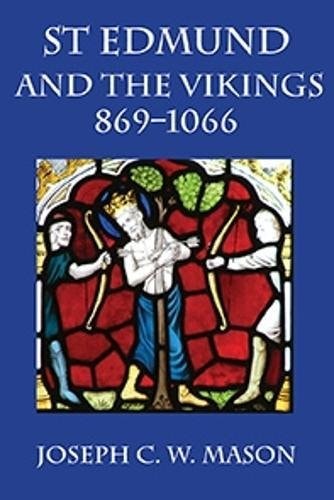
St Edmund and the Vikings, 869-1066
0
0
As an Amazon Associate and affiliate partner, Menrva Books earns from qualifying purchases. Learn more
Author Description
Product Description King Edmund's short reign over the Anglo-Saxon kingdom of East Anglia was marred by invasion by Vikings from Denmark. Edmund himself was killed by them. It is not certain how effectively he resisted, or whether his actions contributed to the invaders' subsequent decision to withdraw, leaving no settlers behind them. He won no great battle. But the reality that underlies these scant and unpromising facts provided fertile soil for the growing cult and legend of the most celebrated of all Anglo-Saxon royal saints: dedicatee of dozens of churches, whose relics were the object of great pilgrimages, and who was regarded for some time as patron saint of England. Successive hagiographers overlaid the facts with their own layers of interpretation and invention, until it became impossible to draw a line between the truth and its embellishment. Only believers in miracles would accept that Edmund's severed head spoke; but was he the chaste, peace-loving man whom Abbo of Fleury depicted, or were the earlier descriptions of a powerful warrior more accurate? And why did subsequent generations of the Vikings whose arrival he opposed so determinedly play a large part in fostering his legend? Joseph Mason roots his account in the Viking period: the last days of the life of the real man, and the first decades of the development of his cult. He focuses on the Vikings and Edmund's interaction with them, both before and after his death, and he draws primarily on unconventional sources of information. The written record might be scarce, but can we build a better picture by looking too at the pattern of church dedications to Edmund, at place names, and at the archaeological record? Mason argues that these traces, albeit sparse, provide valuable evidence that suggests how and where the Vikings travelled, where the impact of their invasion was greatest, and where the source of his subjects' gratitude to Edmund - which was surely the main factor in his acclam
Menrva's Summary
THE THESIS
This book investigates the historical figure of King Edmund of East Anglia and his complex relationship with the invading Vikings, examining the scant historical facts against the backdrop of his later legendary status. Joseph Mason, drawing on his expertise in the Viking period, reconstructs the life of the real Edmund and the initial development of his cult, focusing on his interactions with the Vikings both during his life and after his death. The author utilizes unconventional sources, including church dedications, place names, and archaeological evidence, to supplement the limited written records. Mason posits that these traces offer valuable insights into Viking movements, the impact of their invasions, and the origins of Edmund's enduring veneration.
THE SCOPE MAP
- The historical context of the Viking invasions of Anglo-Saxon England, specifically the Danish incursions into East Anglia.
- An examination of the life and reign of King Edmund, including the circumstances of his death at the hands of the Vikings.
- Analysis of the development of the cult and legend of St. Edmund, from his death to his status as a royal saint and patron.
- Exploration of the relationship between Edmund and the Vikings, both in his lifetime and in the subsequent fostering of his legend by later Viking generations.
- The use of unconventional sources such as church dedications, place names, and archaeological findings to reconstruct historical events and veneration patterns.
- Discussion on the debate between Edmund as a peace-loving saint versus a warrior king, based on differing historical accounts and interpretations.
- An argument for how sparse but valuable evidence can build a picture of Viking travel, invasion impact, and the source of subjects' gratitude.
THE AUTHORITY PERSPECTIVE
This work is positioned as a scholarly examination of a pivotal figure in Anglo-Saxon history, likely appealing to academics and enthusiasts of medieval history and the Viking Age. The author's approach of integrating archaeological and toponymic evidence with traditional historical accounts suggests a comprehensive and nuanced perspective on the period. The book aims to provide a more grounded understanding of St. Edmund by distinguishing historical fact from later embellishment.
Page Count:
158
Publication Date:
2018-01-01
Publisher:
Lasse Press
ISBN-10:
199977521X
ISBN-13:
9781999775216
Non-Fiction
History
Viking Age
Saints
Community Tags
Similar Books