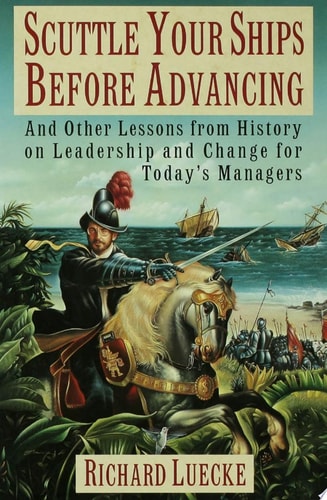
Scuttle Your Ships Before Advancing: And Other Lessons from History on Leadership and Change for Today's Managers
0
0
As an Amazon Associate and affiliate partner, Menrva Books earns from qualifying purchases. Learn more
Author Description
In the spring of 1942, Japan's Admiral Yamamoto devised an ingenious strategy to attack Midway Island and deliver the knockout punch of the war in the Pacific. His elegant operational plan--which involved elaborate traps and diversions and required clockwork coordination--was founded on complete faith that he could predict the Americans' every move. But the perfect plan went wrong, and Japan's elite Strike Force was crushed, losing four carriers, over three hundred aircraft, and 2,500 men.What can today's business managers learn from Yamamoto's stunning defeat at the Battle of Midway? A great deal, according to Richard Luecke, and in Scuttle Your Ships Before Advancing, he illuminates lessons to be learned from Yamamoto and other leaders who have faced memorable crises. We find, for instance, the epitome of decisiveness and entrepreneurialism in Hernan Cortes, as he and a small band of 16th-century adverturers risked everything in a bold gamble for the Aztec empire (the book's title, Scuttle Your Ships, refers to Cortes' strategy that kept his men moving forward). Underdogs who would challenge the status quo can look to France's Louis XI, the "Spider King," and learn how he undermined entrenched rivals through patience and cunning. The Emperor Hadrian, in his consolidation of the sprawling Roman Empire, provides a brilliant model for managing today's multinational corporation. And attitudes toward technology and innovation are vividly illustrated by the 15th-century Battle of Agincourt, in which the stubborn refusal of the French to adopt their English enemy's weapon--the longbow--led to their massacre. From these and other historical episodes, Luecke shows how leadership, daring, and artful administration meant the difference between success and failure. He draws explicit lessons for managers from these long-ago events, and he also reveals parallels in the recent experiences of major corporations from GM to Shearson Lehman. And along the way, he evokes portraits of
Menrva's Summary
THE THESIS
Can historical military and political strategies provide actionable frameworks for modern corporate management and organizational change? Richard Luecke, an experienced business writer, utilizes historical case studies to extract principles of leadership, risk management, and innovation. By juxtaposing the failures and successes of figures like Admiral Yamamoto, Hernan Cortes, and Emperor Hadrian against contemporary corporate challenges, the author argues that the fundamental dynamics of decision-making remain constant across centuries.
THE SCOPE MAP
What You Will Find
- Historical analysis of military engagements including the Battle of Midway and the Battle of Agincourt.
- Strategic frameworks for managing multinational corporations and navigating organizational change.
- Comparative case studies linking 16th-century conquest tactics to modern entrepreneurial risk-taking.
- Lessons on technological adoption and the dangers of institutional inertia.
THE AUTHORITY PERSPECTIVE
Experts and business readers often note that the book provides a unique, narrative-driven approach to management theory that avoids dry academic jargon. It is frequently cited as a useful resource for managers seeking to apply historical perspective to current organizational strategy and leadership dilemmas.
Page Count:
199
Publication Date:
1994-01-15
Publisher:
Oxford University Press
ISBN-10:
019508408X
ISBN-13:
9780195084085
History
Business
Management
Strategy
Leadership
Community Tags
Similar Books





Reader Comments
Share Your Thoughts
No comments yet. Be the first to share your thoughts!