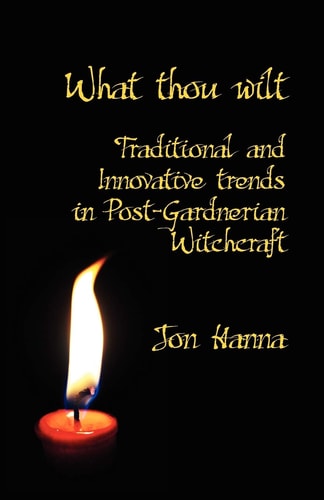
What Thou Wilt: Traditional and Innovative Trends in Post-Gardnerian Witchcraft
0
0
As an Amazon Associate and affiliate partner, Menrva Books earns from qualifying purchases. Learn more
Author Description
The publication from 1954 of Gerald Gardner's non-fiction works on witchcraft has led to the current public existence of two different trends of religious and magical belief and practice, both which identify themselves as "Wicca". One form places a strong emphasis upon the transmission of traditional practices and a form of initiatory lineage similar to that practised by Gardner himself. The other covers a wider range of views on each of these aspects, but with the most common position being a strong distance between the traditional practices-giving a greater importance to innovation-and a complete or near-complete abandon-ment of the concept of initiatory lineage. Both trends often see themselves and each other as being within a wider religio-magical stream of Post-Gardnerian Pagan Witchcraft of which the innovative form is a larger part, though in different ways. The traditional view of the innovative form typically labels that form "Eclectic" even in cases where the practitioners would understand "Eclectic" differently, and considers it to be something outside of what it terms "Wicca". The innovative form generally labels all Post-Gardnerian Pagan Witchcraft, or beyond, as "Wicca", and as such recognizes all traditional practitioners as Wiccan but does not generally make more signi-fi-cant distinctions between the various schools. The traditional stream considers the differences between the two streams as significant to the point of typicality while the innovative stream considers the differences as much less important. This book examines the differences and offers insights into both.
Menrva's Summary
THE THESIS
This book investigates the divergent paths within Post-Gardnerian Pagan Witchcraft, examining the tension between traditional practices and innovative trends. The publication of Gerald Gardner's foundational works in 1954 marked a pivotal moment, leading to the emergence of two distinct, yet related, forms of religious and magical practice identifying as
THE SCOPE MAP
- An examination of the traditional stream of Wicca, emphasizing initiatory lineage and Gardnerian practices.
- An analysis of the innovative stream of Wicca, prioritizing new developments and often abandoning initiatory lineage.
- Exploration of the differing perspectives each trend holds regarding the other, including terminology like 'Eclectic'.
- Insights into the significance each stream places on the differences between them.
- Discussion of the broader religio-magical context of Post-Gardnerian Pagan Witchcraft.
- An overview of the historical development stemming from Gardner's initial publications.
THE AUTHORITY PERSPECTIVE
The book offers a comparative analysis of two major currents within modern witchcraft, providing a framework for understanding their distinct philosophies and practices. It aims to illuminate the differing viewpoints held by traditionalists and innovators regarding lineage, innovation, and the very definition of Wicca. The work is positioned to offer clarity for both practitioners and observers of these evolving spiritual paths. The author's approach suggests a balanced examination of these complex religious and magical traditions.
Page Count:
219
Publication Date:
2010-01-01
Publisher:
Evertype
ISBN-10:
1904808433
ISBN-13:
9781904808435
Religion
Non-Fiction
History
Sociology of Religion
Witchcraft
Paganism
Wicca
Community Tags
Similar Books