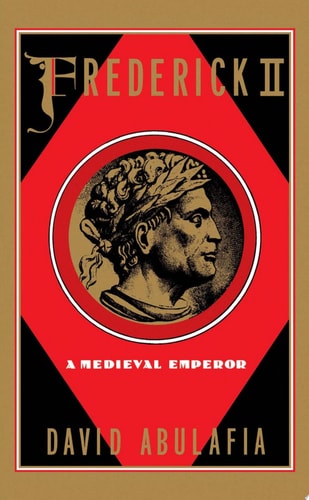
Frederick II: A Medieval Emperor
0
0
As an Amazon Associate and affiliate partner, Menrva Books earns from qualifying purchases. Learn more
Author Description
Frederick II of Hohenstaufen, Holy Roman Emperor, King of Sicily, King of Jerusalem, has, since his death in 1250, enjoyed a reputation as one of the most remarkable monarchs in the history of Europe. His wide cultural tastes, his apparent tolerance of Jews and Muslims, his defiance of the papacy, and his supposed aim of creating a new, secular world order make him a figure especially attractive to contemporary historians. But as David Abulafia shows in this powerfully written biography, Frederick was much less tolerant and far-sighted in his cultural, religious, and political ambitions than is generally thought. Here, Frederick is revealed as the thorough traditionalist he really was: a man who espoused the same principles of government as his twelfth-century predecessors, an ardent leader of the Crusades, and a king as willing to make a deal with Rome as any other ruler in medieval Europe.Frederick's realm was vast. Besides ruling the region of Europe that encompasses modern Germany, Czechoslovakia, Poland, eastern France, and northern Italy, he also inherited the Kingdom of Sicily and parts of the Mediterranean that include what are now Israel, Lebanon, Malta, and Cyprus. In addition, his Teutonic knights conquered the present-day Baltic States, and he even won influence along the coasts of Tunisia. Abulafia is the first to place Frederick in the wider historical context his enormous empire demands. Frederick's reign, Abulafia clearly shows, marked the climax of the power struggle between the medieval popes and the Holy Roman Emperors, and the book stresses Frederick's steadfast dedication to the task of preserving both dynasty and empire. Through the course of this rich, groundbreaking narrative, Frederick emerges as less of the innovator than he is usually portrayed. Rather than instituting a centralized autocracy, he was content to guarantee the continued existence of the customary style of government in each area he ruled: in Sicily he appeared a mighty despo
Menrva's Summary
THE THESIS
This biography investigates the historical reality of Frederick II of Hohenstaufen, challenging the long-standing perception of him as a forward-thinking, secular innovator. David Abulafia, a distinguished historian of the Mediterranean, utilizes extensive primary source documentation and administrative records to re-evaluate Frederick's reign. He argues that the Emperor was fundamentally a traditionalist whose political and religious actions were consistent with twelfth-century monarchical standards rather than the radical, modernizing vision often attributed to him by later scholars.
THE SCOPE MAP
What You Will Find
- A comprehensive examination of the Holy Roman Empire during the thirteenth century.
- An analysis of the complex power dynamics between the papacy and the Hohenstaufen dynasty.
- Detailed accounts of Frederick's administrative practices in Sicily, Germany, and the Mediterranean territories.
- A critical reassessment of Frederick's reputation regarding religious tolerance and cultural synthesis.
THE AUTHORITY PERSPECTIVE
Historians frequently cite this work as a corrective text that successfully dismantles romanticized myths surrounding Frederick II. Experts highlight the author's rigorous use of archival evidence to provide a more grounded, realistic portrait of medieval governance.
Page Count:
480
Publication Date:
1992-11-26
Publisher:
Oxford University Press
ISBN-10:
0195080408
ISBN-13:
9780195080407
History
Biography
European History
Monarchy
Community Tags
Similar Books