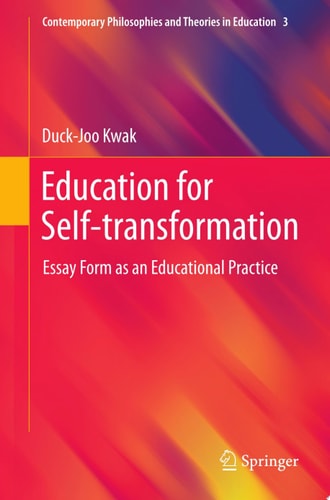
Education for Self-transformation
0
0
As an Amazon Associate and affiliate partner, Menrva Books earns from qualifying purchases. Learn more
Author Description
Exemplifying what it advocates, this book is an innovative attempt to retrieve the essay form from its degenerate condition in academic writing. Its purpose is to create pedagogical space in which the inner struggle of ‘lived experience’ can articulate itself in the first person. Working through essays, the modern, ‘post-secular’ self can guide, understand, and express its own transformation. This is not merely a book about writing methods: it has a sharp existential edge. Beginning by defining key terms such as ‘self-transformation’, Kwak sketches the contemporary debates between Jürgen Habermas and Charles Taylor on the status of religious language in the public domain, and its relationship to secular language. This allows her to contextualize her book’s central questions: how can philosophical practice reduce the experiential rift between knowledge and wisdom? How can the essay form be developed so that it facilitates, as praxis, pedagogical self-transformation? Kwak develops her answers by working through ideas of George Lukács and Stanley Cavell, of Hans Blumenberg and Søren Kierkegaard, whose work is much less familiar in this context than it deserves to be. Kwak’s work provides templates for new forms of educational writing, new approaches to teaching educators, and new ways of writing methodology for educational researchers. Yet the importance of her ideas extends far beyond teaching academies to classroom teachers, curriculum developers – and to anyone engaged in the quest to lead a reflective life of one’s own.
Menrva's Summary
THE THESIS
This book investigates how the essay form can be revitalized to facilitate pedagogical self-transformation. The author, Duck-Joo Kwak, aims to create a space for the articulation of 'lived experience' through the first-person essay, guiding individuals toward understanding and expressing their own transformation. The work engages with contemporary debates between Jürgen Habermas and Charles Taylor regarding religious and secular language, and draws upon the ideas of George Lukács, Stanley Cavell, Hans Blumenberg, and Søren Kierkegaard to explore the experiential rift between knowledge and wisdom. Kwak's central questions revolve around how philosophical practice can bridge this gap and how the essay form can serve as a praxis for educational self-transformation.
THE SCOPE MAP
- Exploration of the essay form as a pedagogical tool for self-articulation.
- Analysis of the 'post-secular' self and its capacity for transformation.
- Contextualization within contemporary philosophical debates (Habermas vs. Taylor) on language and public discourse.
- Examination of the experiential rift between knowledge and wisdom.
- Application of philosophical concepts from George Lukács, Stanley Cavell, Hans Blumenberg, and Søren Kierkegaard.
- Development of new forms of educational writing and methodology for researchers.
- Guidance for classroom teachers and curriculum developers.
- Consideration for individuals pursuing a reflective life.
THE AUTHORITY PERSPECTIVE
The book is presented as an innovative attempt to retrieve the essay form from academic degeneracy, focusing on the articulation of lived experience for self-transformation. It engages with significant philosophical debates and thinkers to address how philosophical practice can reduce the gap between knowledge and wisdom and how the essay can facilitate pedagogical self-transformation. The work offers new approaches for educational writing, teaching, and methodology, extending its relevance beyond academic circles to practitioners and those seeking a reflective life. The author's approach is characterized by a sharp existential edge, aiming to guide the modern self through its own transformative process.
Page Count:
150
Publication Date:
2011-10-12
Publisher:
Springer Nature
ISBN-10:
9400724012
ISBN-13:
9789400724013
Philosophy
Non-Fiction
Self-help
Pedagogy
Existentialism
Education
Community Tags
Similar Books