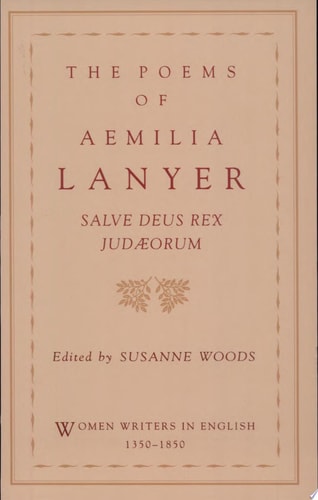
The Poems of Aemilia Lanyer: Salve Deus Rex Judaeorum
0
0
As an Amazon Associate and affiliate partner, Menrva Books earns from qualifying purchases. Learn more
Author Description
Aemilia Lanyer (1569-1645) was the first woman poet in England who sought status as a professional writer. Her book of poems is dedicated entirely to women patrons. It offers a long poem on Christ's passion, told entirely from a woman's point of view, as well as the first country house poem published in England. Almost completely neglected until very recently, her work changes our perspective on Jacobean poetry and contradicts the common assumption that women wrote nothing of serious interest until much later. Mistress and friend of influential Elizabethan courtiers, Lanyer gives us a glimpse of the ideas and aspirations of a talented middle class Renaissance woman.
Menrva's Summary
THE PULSE
Aemilia Lanyer asserts her voice as a professional poet within the rigid, male-dominated literary landscape of the Jacobean era. Lanyer navigates the social hierarchies of the English court by dedicating her work to influential female patrons, thereby securing her position as a writer. Her poetry functions as a complex negotiation of religious devotion and social critique, utilizing the framework of the long-form narrative poem to reframe biblical history. The work operates within the constraints of Renaissance verse, employing classical allusions and formal structures to challenge contemporary gender norms.
INSIDE THE PAGES
- Reinterpretation of the Passion of Christ from a female perspective
- Pioneering use of the country house poem genre in England
- Dedicatory epistles addressed to various female patrons
- Exploration of the social and intellectual aspirations of Renaissance women
- Use of formal, elevated verse characteristic of the Jacobean period
- Critique of patriarchal structures within religious and social contexts
- Integration of personal experience with theological reflection
- Stylistic focus on moral instruction and social commentary
THE COLLECTIVE ECHO
Discussion often centers on Lanyer's role as a foundational figure in the history of women's writing in England. Readers frequently highlight the significance of her perspective on the Passion, which provides a distinct counter-narrative to traditional male-authored accounts of the period. Critics emphasize the technical skill displayed in her country house poem, noting how it establishes a template for later poets while maintaining a unique focus on female agency. The work is widely regarded as a vital text for understanding the intellectual life of middle-class women in the Renaissance, generating ongoing interest in its thematic depth and historical context.
Page Count:
192
Publication Date:
1993-09-16
Publisher:
Oxford University Press
ISBN-10:
019508361X
ISBN-13:
9780195083613
Poetry
British literature
Women Writers
Renaissance
Community Tags
Similar Books